


Every enterprise has identity debt: over-privileged accounts, insecure credential storage, and poor control of account lifecycle are just a few weaknesses we see all the time. But what if that debt could be turned into a strategic advantage against attackers?
CISA recently described decoys, tripwires, breadcrumbs, and honeytokens as practical mechanisms for detecting post-compromise activity. It got me thinking about how we can apply this defensive concept at the identity layer, where an attempted authentication can become both a detection signal and an inline containment decision. In other words, is there a world where we can weaponize Identity Security controls as a set of simple but effective tripwires across enterprise environments?
I think there is—and, even better, I think it has potential to turn any environment into the kind of classic laser hallway you see in heist movies, with red beams criss-crossing the route to the goal, ready to alert and ready to stop the latest threats.
So, in this blog, we’re going to look at how organizations can turn the same weaknesses attackers target into opportunities to generate rapid, high-fidelity signals with minimal operational risk.
But first: What are cyber decoys?
Cyber decoys are legitimate-looking systems, accounts, and data designed to distract and detect adversaries or facilitate collection of threat intelligence.
When operationalized with monitoring and alerting, they can become tripwires to provide high-fidelity signals to defenders. CISA also recommends mapping decoy coverage to MITRE ATT&CK and MITRE Engage, continuously testing the controls, and refining them based on observed adversary behaviour.
Why does this matter now?
The Hugging Face attack alone generated 17,000 unique events to analyse and correlate in a matter of a few days. As we prepare for a reality where attacks like these are commonplace, generating signal from noise to drive effective detection, response and containment has never been more important.
The focus is primarily on enhancing correlation. Hugging Face recommended that organizations focus on this in their post-incident call, having used an open-source model successfully—evidently a good investment. However, even the world’s most effective correlation engine will remain subject to data pipeline and ingestion constraints, some of which are owned by platform providers and cannot be optimized directly.
Generating high-fidelity signals as events unfold complements runtime controls that contain the threat, providing deeper visibility into attacker activity while enabling more informed defensive actions in real time.
Safe deception in the age of machine-speed threats
The aim of a deception strategy is to expose attackers and increase the cost and difficulty of attacks by creating a misleading picture of the environment and its resources (i.e., identities).
In agentic terms, the goal is to increase the compute/token cost of attack, use up context window, and buy time. In the future, it’ll be to funnel agentic attackers towards pre-designed traps to cause the agent to loop without escape.
Deception relies on something—for example, an identity with high privileges and easily-acquired credentials—appearing significantly less monitored, controlled, and secure than it actually is.
Without this differential between appearance and security, and supported by traditional detection and response alone, adding designed ‘honey tokens’ in the age of machine-speed threats may not generate a response fast enough to prevent exploitation of the token itself. Decoys and tripwires must therefore be safe. In other words, they must not have possible negative security implications in and of themselves.
Importantly, a safe tripwire turns the traditional detect > contain methodology, and reliance on response-time, on its head: the containment action that took place is the detection that arms your SOC with a signal, with full context of what happened.
Finally, given the rise of machine-speed threats, tripwires must not provide additional information as to the defensive posture of the organization when triggered. Transparency of the tripwire—which must not be able to be enumerated or discovered directly will become key to identifying and defeating machine-speed threats.
Identity is where the attack becomes the control point
AI attacks do not move through an environment in neat, human-sized steps. They enumerate identities, test permissions, reuse valid credentials and tokens, and pivot across trust boundaries until they find a path that works.
As we’ve already seen, the Hugging Face investigation reconstructed more than 17,000 attacker actions, grouped into approximately 6,280 clusters. The important lesson is not only the volume of activity, but the repeated identity pivots hidden inside it: credential theft, workload impersonation, token reuse, privilege escalation, and lateral movement.
That makes identity a powerful place to deploy tripwires. The tripwire should not only sit on a file, share, or endpoint. It should sit on the attempted identity path itself:
- An identity requests access to an unexpected resource, in an unexpected protocol, or in a way that deviates from its baseline.
- The request is evaluated using identity, source, destination, protocol, behaviour, and context.
- The access is denied or fenced inline.
- The same event generates a high-fidelity signal for the SOC.
- Related identities and adjacent attack paths can be investigated or contained.
The attacker sees a normal access denial. The SOC sees the identity, attempted destination, protocol, source, sequence of activity, and potential attack path.
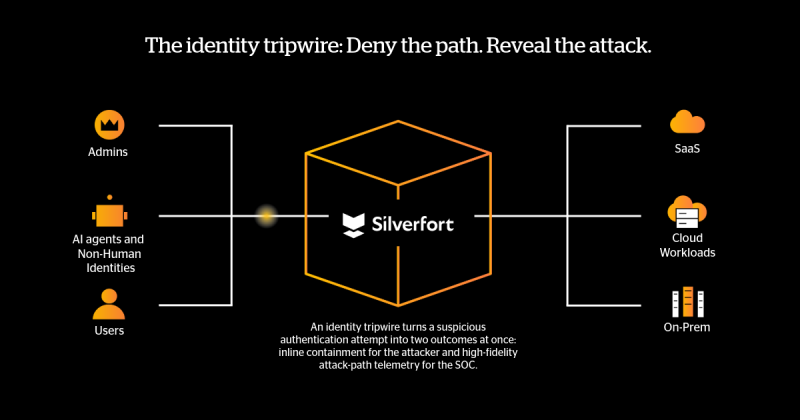
For a machine-speed attack, detection alone often arrives too late. An identity tripwire functions as a control-flow interrupt: it breaks the sequence between authentication and the next step in the attack chain.
Instead of allowing the attacker to authenticate, discover, pivot, and escalate while defenders correlate events after the fact, the control can deny the risky authentication attempt at the point where the path is exercised. This changes the operating model from detect → correlate → respond to deny → detect → contain, resulting in a synchronous control that limits blast radius while preserving the evidence needed for investigation.
How can we leverage identity debt for this?
Identity is ripe for deception. Traditional identity debt such as over-privileged accounts, shadow admins, insecure credential storage, use of legacy protocols, and loose account lifecycle management is common—maybe even ubiquitous. These do not need to be designed and created because they already exist!
I want to be clear here: hygiene is still really important. Just because it’s possible to weaponize these existing issues, doesn’t mean good hygiene practices can be neglected.
The real question is how do we create safe tripwires?
There are three key premises to creating effective, safe tripwires:
- A differential exists between the outward appearance of the account (utility to attackers), and the security state (monitored, controlled).
- Usage of the tripwire does not have security implications (i.e., it does not make our security position worse).
- Tripping the tripwire must not provide additional defensive context to the attacker to learn from; it must be to the attacker.
Inline identity controls allow for us to meet these three conditions. For example, deny policies create the tripwire alert to the SOC team, while denying the attacker information about why the containment activity occurred. Likewise, service accounts can be ‘fenced’ down to their standard, accepted, recorded usage behaviour and deny anomalies so, should anomalous usage be detected, we can both directly deny the usage of the account, and notify the SOC with a high-fidelity, rapid alert with full context for further action and wider correlation. All of this can happen without the agent seeing anything except ‘access denied’.
Some other cases where we can weaponize identity as tripwires (you can read more in the appendix below):
- If connections to Tier 0/1 must be via bastions or PAW and are not
- If dormant accounts become active
- If admin accounts are used in a highly unusual way
- If a legacy protocol is being used to access a sensitive server
- If a low-privilege identity is attempting to reach a Tier 0 system
When one of these edges is exercised, the response should combine three actions: deny or restrict the attempted access, generate a high-confidence alert, and expose the surrounding identity relationships for investigation. This is specifically a control against AI attacks and their speed, persistence, and ability to test many paths in parallel.
What this means for security in the age of machine-speed threats
As we move into the next phase of threats—autonomously driven by AI models with the capacity to enumerate and hold your full environment and its vulnerabilities in their context window—two challenges emerge:
- How do we generate signal amongst the massive volume of noise?
- How do we do this in a way that does not require a loop of detect > correlate > respond, dependent on replication and processing times and humans in the loop?
CISA defines tripwires as decoys where interaction generates an alert. Silverfort extends that idea into the authentication path, where identity-based deny and segmentation can block access before lateral movement or privilege escalation completes. While a conventional tripwire detects interaction, an identity tripwire can detect, deny, and contain the attempted path in the same control loop.
Rethinking how we weaponize identity against attackers—by leveraging the identity debt that already exists—allows us to generate high-quality signal to cut through the noise, while having containment built-in. The containment activity generates the signal, rather than the signal requiring containment activity.
Doing this allows for more rapid threat detection, safely, while denying any information to the model that may help it progress its attack—and gives us a pathway to active defense in the future by funnelling agents to useless traps in an endless loop.
If you want to see how Silverfort can stop AI attacks inline and at runtime, book a demo here.
Identity tripwire appendix
| Tripwire | Suspicious interaction | Recommended response |
|---|---|---|
| Decoy service account | Authentication from any source or destination outside its tightly defined baseline | Generate an alert and apply a virtual fence |
| Dormant privileged account | Login attempt against a disabled, unused, or never-used account | Deny the request and investigate the originating identity and host |
| Decoy SPN/Kerberos path | TGS request for a decoy service identity from an unexpected system | Alert on possible service-account discovery or credential theft and virtually fence it |
| Tier-0 access edge | Non-admin identity attempts authentication to domain controllers or identity infrastructure | Block inline and surface the full attempted path |
| Legacy protocol path | NTLM or other weak protocol used against a sensitive resource from an unusual source | Deny or segment the protocol-level access and generate an alert |
| Executive/admin breadcrumb | A decoy link, file, or share is accessed by an identity that should never touch it | Treat as a likely compromise signal and initiate identity containment |
