Identity-first incident response
Stop the incident,
never the business.
Stop attacks in minutes, not days. Enforce controls instantly through identity, isolate compromised accounts, and stop lateral movement before an incident becomes an outage, without shutting the business down.
The Silverfort Identity Security Platform
One platform to contain incidents at the identity layer.
The fastest, simplest way to contain and respond to attacks.
Silverfort puts identity at the center of incident response. See authentication activity and enforce controls inline, at runtime, from a single platform. Reach the systems your EDR and other security tools can't. Contain faster. Respond faster. Recover faster.

Contain in minutes. Recover in hours.

Keep the business running.

Every incident leaves you stronger.

Full coverage, even where EDR can't reach.
An identity-first incident response lifecycle
Silverfort aligns with the IR lifecycle while reordering it around identity-first containment and visibility.
01
Preparation
Close the gaps attackers exploit before an incident strikes. Enforce MFA across all users (including admin accounts and tools), eliminate standing privileges, and establish authentication policies that can be tightened instantly.
02
Detection
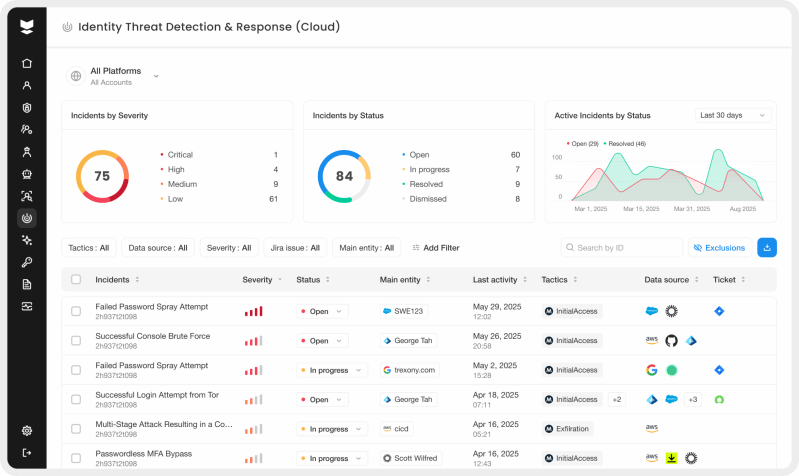
Surface threats early. Abnormal access behavior, lateral movement attempts, and policy violations give your team the signals to immediately identify an emerging breach, and discover which identities are compromised and how attackers are moving.
03
Containment
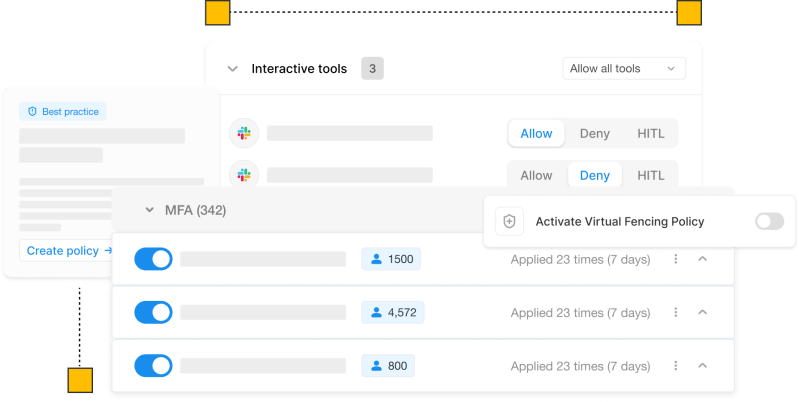
Immediately restrict access for high-risk users, privileged accounts, and service accounts with virtual fences, MFA challenges, or deny policies. Stop malicious spread immediately, without waiting for every compromised account to be uncovered.
04
Eradication
Remove attacker footholds by revoking compromised credentials and eliminating unauthorized access paths. Use unified authentication logs to confirm that no persistent access remains across users, devices, or integrated systems.
05
Recovery
Replace temporary lockdown controls with durable access policies and restore normal operations securely. Validate that all restored accounts and service connections meet your Identity Security baseline across your entire identity estate.
06
Lessons learned
Use posture insights and the full attack timeline—from patient zero to every affected system—to understand how access was abused, close structural gaps, and harden your identity estate against the next attack.
See it. Stop it. Come back stronger.
Use identity-first incident response to see every compromised access path, shut down malicious activity without disrupting legitimate users, and lean on the attack itself to sharpen your defenses—all from the same platform.

See every compromised identity and access path
Start with a unified view of your identity activity.
- Aggregate authentications across AD, Entra ID, cloud IdPs, VPNs, PAM, and key apps
- Identify active users, admins, and service accounts during the incident
- Trace lateral movement to understand the real blast radius

Contain the attack without killing productivity
Lock down malicious access in minutes.
- Enforce MFA or block access for users, admins, and service accounts inline
- Stop risky activity, including command-line tools and legacy protocols, before it reaches critical systems
- Keep legitimate users working while shutting down attacker movement

Turn containment into detection
Let attacker behavior expose compromised identities.
- Use denied access and failed MFA as high-confidence signals
- Surface accounts that continue triggering policies and prioritize investigation
- Pivot quickly from identity to impacted systems

Accelerate recovery and harden identity posture
Recover on your terms, not the attackers
- Transition from deny policies to adaptive access as systems are restored
- Strengthen controls for compromised identities
- Remediate exposures like shadow admins, risky delegations, and legacy protocols
Built for any incident response scenario
Ransomware and lateral movement
Stop propagation by enforcing MFA and segmentation on the same tools attackers use to spread—RDP, SMB, PsExec, PowerShell, WMI, and more.
Compromised admins and infrastructure
Lock down domain admins, admin accounts, and identity infrastructure access without taking domain controllers offline.
Exposed service accounts and NHIs
Discover and virtually fence service accounts so they can’t authenticate outside their normal behavior, preventing lateral movement and privileged escalation.
Work alongside your IR team—or ours.
Contain faster, without changing how you respond. Silverfort integrates directly into your environment and becomes an active control layer during the incident, whether you’re working with:
- Your internal SOC
- A global incident response firm
- Or you need immediate guidance
See how Silverfort powers identity-first incident response.
Set up a demo to see how Silverfort helps IR teams contain identity attacks, accelerate investigations, and recover faster—without sacrificing business continuity.