
AI agents run your business. Who runs your AI agents?
Enforce identity controls the moment an AI agent acts. Eliminate credential sprawl, overprivileged agents, and ungoverned automation—without rebuilding your stack or stalling innovation.
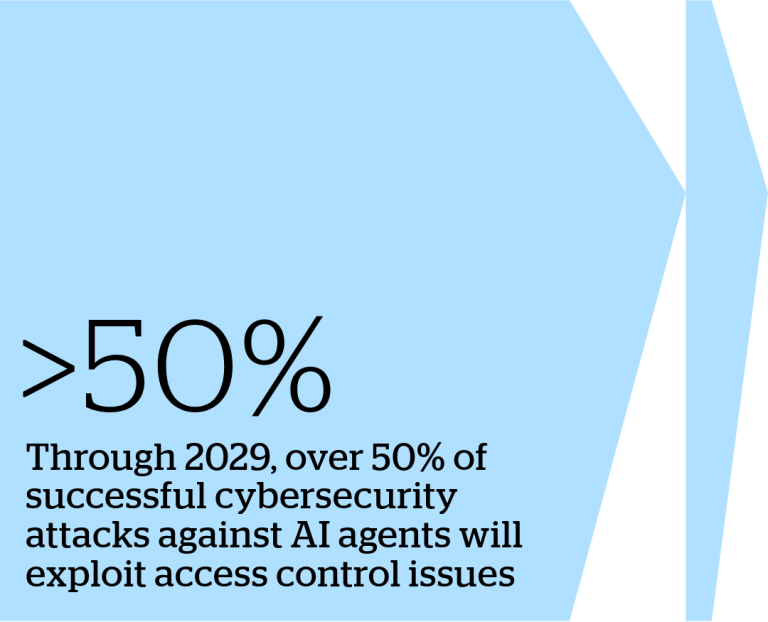
AI agents are multiplying. Security is not.
AI agents are often granted more privilege than humans. Yet most organizations have no inventory, no ownership model, and no runtime controls to stop them.
Now factor in adversaries using AI-powered attack models like Mythos—purpose-built to probe, exploit, and move laterally at machine speed.
When your agents are overprivileged and your adversaries are autonomous, the window to act is very small.
AI threats come from two directions. Identity controls both.
Whether the threat is external or internal, it plays out through what an agent can access and what it's allowed to do. In other words, both risks share one control plane: identity.

External attackers exploiting AI agents
- Malicious takeover of an agent
- Poisoned MCP servers with malicious instructions
- Prompt injection attacks that redirect agent behavior
- AI-powered attacks that reach agent credentials and move at machine speed

Internal risks from AI agents
- Agents that exceed their designated scope
- Prohibited agent-to-agent delegation chains
- Behavioral drift: agents that act outside original intent
What you need to secure AI agents
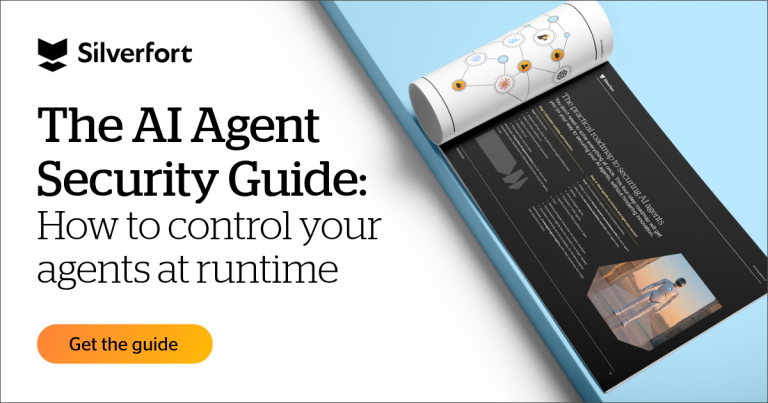
The AI Agent Security Guide: How to control your agents at runtime
Traditional IAM, PAM, and monitoring tools weren’t built for AI agents. If you’re looking for a practical framework to gain visibility, enforce accountability, and protect every agent at runtime, get The AI Agent Security Guide here:
What you need to secure AI agents
See it. Assess it. Control it.
Traditional security tools weren't built for AI agents. They don't know agents exist, can't map their relationships to humans and systems, and have no way to enforce policy at runtime, before an agent takes an action you'd never have approved. Effective AI agent security requires three things working together:

Continuous and complete visibility

Posture and risk assessment

Runtime enforcement and control
Introducing the identity-first control plane for AI agents
Silverfort approaches AI agent security the way it has always approached Identity Security: with a single, unified platform that eliminates silos and enforces control across every environment, without requiring agents to be rebuilt, re-routed, or retrofitted.
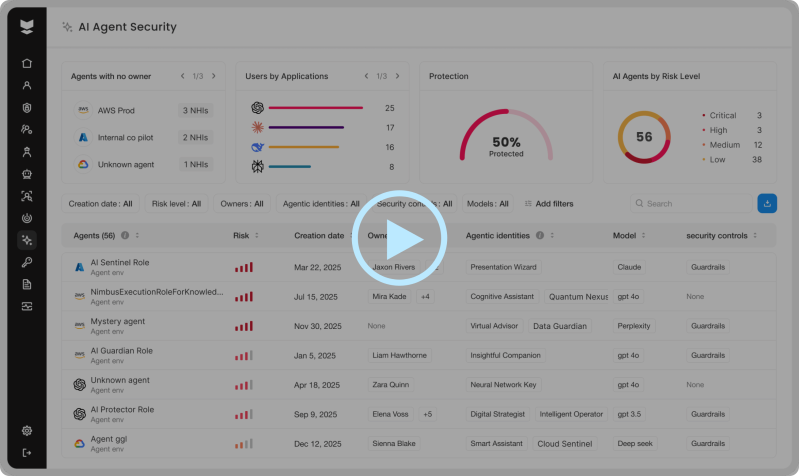
How AI agent security with Silverfort works
From blind spots to runtime control in three steps
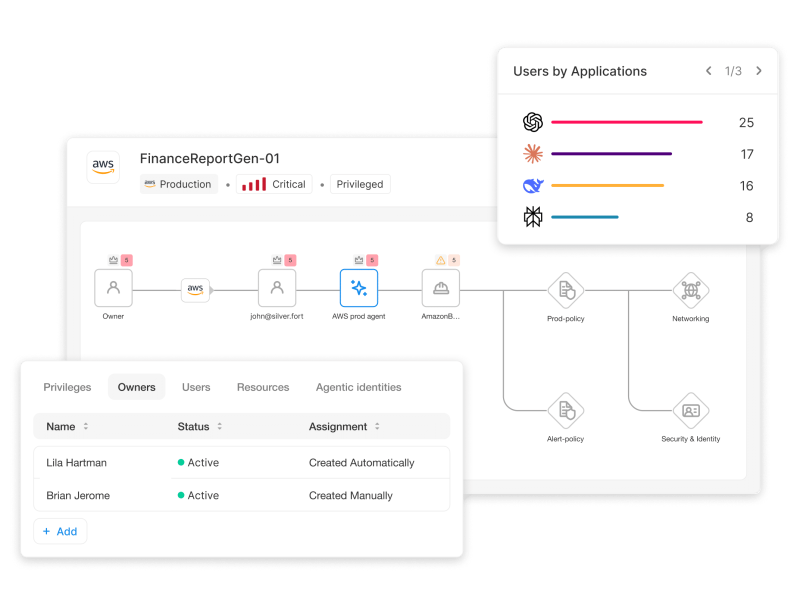
Step 1: Visibility and discovery
Silverfort automatically discovers every AI agent across AWS, Azure, GCP, Entra ID, Microsoft Copilot Studio, OpenAI, and Anthropic.
Each agent is instantly mapped to its human owner, giving you clear accountability and a complete, real-time inventory. Associated NHIs and connection paths are surfaced alongside each agent, so you understand the full context and its true blast radius—not just what an agent is, but what it's connected to.
Step 2: Posture and risk management (AI-SPM)
Silverfort's AI Security Posture Management continuously assesses every agent for risky configurations and exposures, including over-privileged access, supply chain risks, and behavioral drift.
Findings are prioritized by sensitivity and real-world impact, so your team knows exactly where to focus. Visual activity timelines reveal the full blast radius of any agent, helping you understand risk before it becomes a breach.
Step 3: Enforcement and control
Silverfort enforces Least Privilege policies at runtime, before an agent executes.
Policies are defined by agent identity, user context, target application, and action type. Access requests are allowed or blocked in real time, and all policies are managed from a centralized dashboard. Enforcement is delivered via MCP Gateway for broad coverage, and via native integrations with leading agentic platforms for deep, platform-level control.
Two approaches to runtime control
The only enforcement model that meets agents where they are
AI agents don't all run the same way. Some operate within managed enterprise platforms, while others communicate across open ecosystems via standard protocols. Silverfort's unique enforcement strategy combines two complementary architectural approaches to ensure complete runtime control across your environment.
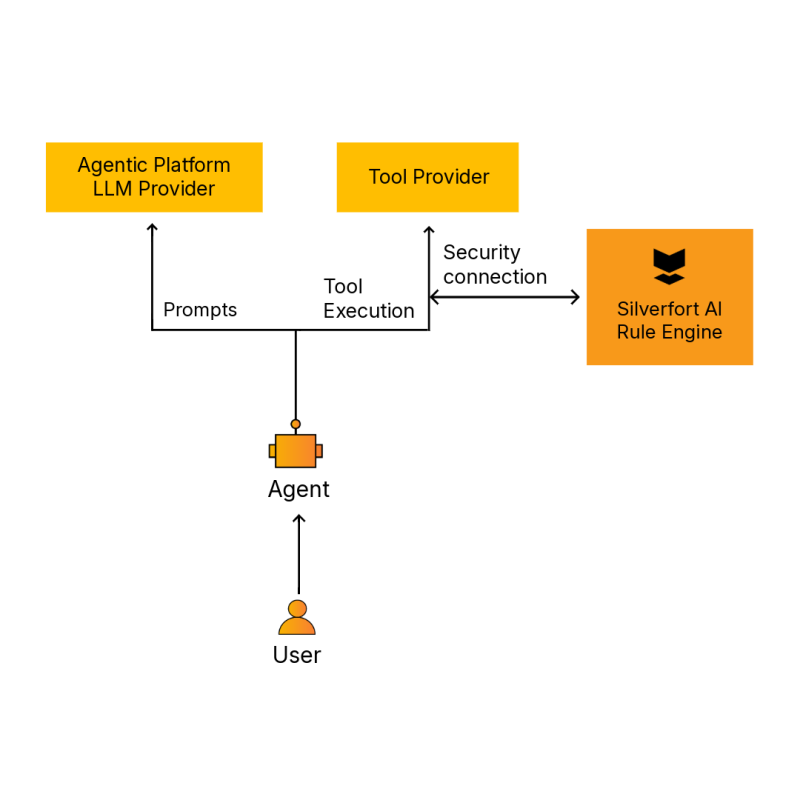
Native integrations with agentic platforms
Deep control at the source
Native integrations go deeper. By connecting directly into the control plane of leading agentic platforms, Silverfort enforces policies without requiring agent owners to route traffic through a separate gateway.
Best for:
- Cloud-managed enterprise AI environments
- SaaS-based agentic platforms (e.g., Microsoft Copilot Studio)
- Consistent, platform-native policy enforcement within your managed enterprise ecosystem
- Environments where scale, platform resilience, and zero workflow disruption are critical
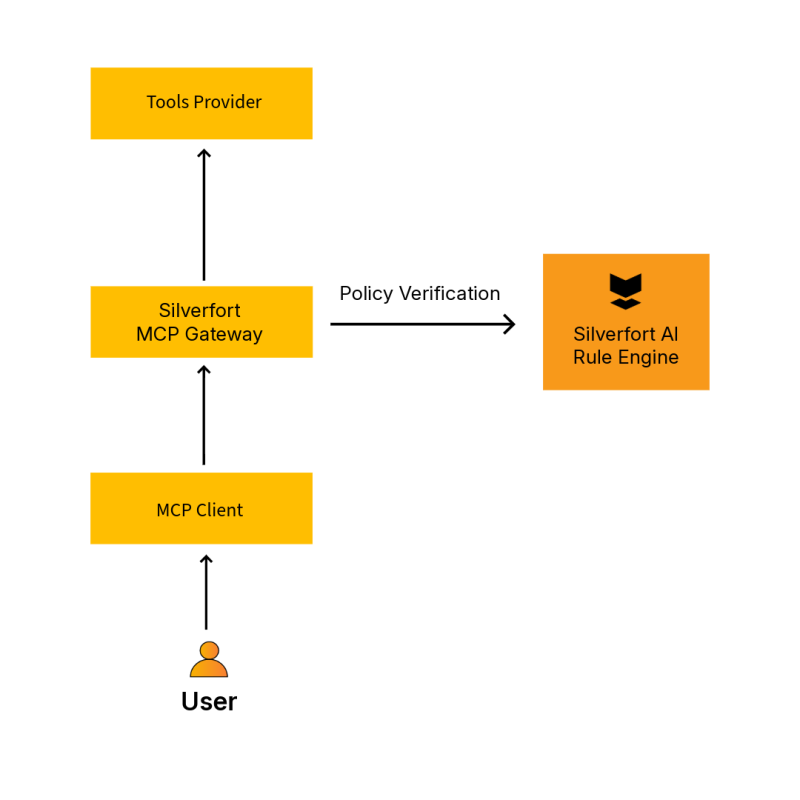
MCP Gateway
Universal inline security for protocol-based agents
The MCP Gateway is a universal enforcement layer that sits between AI agents and the Model Context Protocol (MCP) servers they access. By routing agent traffic through the MCP server framework, Silverfort evaluates identity and policy in real time, intercepting unauthorized tool calls before they execute.
Best for:
- Custom or open-framework AI agents using MCP
- Environments using centralized MCP servers for tool and data access
- Securing agents operating outside of closed, vendor-specific ecosystems
What you can expect
AI agents you can control without hindering productivity
Silverfort gives security teams the visibility, context, and control they need to let AI automation scale—without the sleepless nights.

Complete agent inventory
Know every agent running in your environment. No manual registration, no gaps.

Clear accountability
Every agent linked to a human owner. Every action traceable. No more shadow AI.

Reduced attack surface
Identify and remediate over-privileged agents and enforce Least Privilege immediately.

Runtime protection
Access controlled before execution, not after the fact. Block unauthorized actions in real time.

Unified policy management
One dashboard for all agent policies across cloud, SaaS, and on-prem. No tool sprawl.

Scale AI with confidence
Enable your teams to deploy AI automation fast without security becoming the bottleneck.
Think you know how many AI agents are in your environment?
Find out for certain.

FAQs
What is AI agent security?
AI agent security is the practice of discovering, monitoring, and controlling AI agents to ensure they only access resources and perform actions they’re authorized for. It encompasses visibility into which agents exist in an organization, posture management to identify risky or overprivileged agents, and runtime enforcement to block unauthorized actions before they execute.
Why is AI agent security an Identity Security problem?
AI agents authenticate to systems, request access to resources, and act on behalf of humans, making them a form of identity. The risk they pose is defined by what they can access and what they’re permitted to do. Securing agents therefore requires the same identity-first approach used to secure service accounts, API keys, and other machine identities: visibility, Least Privilege access, and runtime control.
What's the difference between an AI agent and a non-human identity (NHI)?
Non-human identities (NHIs) are machine credentials—API keys, OAuth tokens, service accounts—that authenticate machine-to-machine access. AI agents are task-driven systems that plan, decide, and act using AI models. Agents can use NHIs to authenticate, but they also behave adaptively and can take actions that go far beyond what their credentials technically restrict. Securing agents requires both credential hygiene (NHI security) and behavioral monitoring and guardrails (AI agent security).
What is an MCP Gateway, and why does it matter for AI agent security?
The Model Context Protocol (MCP) is a standard for how AI agents communicate with external tools and services. An MCP Gateway is a security enforcement layer that sits in this communication path, allowing organizations to define and enforce policies on what agents can access and do, without requiring changes to the agents themselves. Silverfort’s MCP Gateway provides universal coverage for any agent, regardless of which platform or vendor it runs on.
How does Silverfort discover AI agents automatically?
Silverfort integrates natively with major cloud platforms and SaaS environments to automatically enumerate AI agents as they’re created and deployed. Discovery requires no manual agent registration and no changes to agent code. Each discovered agent is mapped to its human owner, giving security teams a complete, real-time inventory.
Does Silverfort's AI agent security require changes to existing agents or infrastructure?
No. Silverfort is designed for minimal disruption. Native integrations enforce policies at the platform control plane level, with no changes to agent code required. The MCP Gateway operates as an inline enforcement layer that agents route through, again without requiring agent rebuilds or significant infrastructure changes.
How can securing AI agents help defend against AI-powered attacks?
They’re two sides of the same control plane. AI agents expand what an attacker can reach; AI-powered attack models like Mythos exploit that reach at machine speed. Both are stopped the same way—by evaluating and enforcing identity policy at runtime, before access is granted.