ARE YOU READY FOR FRONTIER AI-POWERED ATTACKS? We are.

Frontier AI attacks move fast. Runtime control is the only thing faster.

New AI models like Anthropic’s Mythos are breaking down defenses at amazing speed. Silverfort enforces identity controls at runtime—the only point in the chain where AI-speed attacks can still be stopped.

Frontier AI statistic

The rules changed. Most security tools didn't.

AI agents execute complete attack chains—reconnaissance, lateral movement, privilege escalation—in one continuous flow. No pauses. No hesitation. No mistakes to detect.

That breaks every major security category built over the past decade, and narrows the window for defenders to respond to milliseconds. The patching or remediation race cannot be won against frontier AI.

Static, admin-time controls can't keep up.

Your identity environment is expanding faster than ever. AI agents spin up and act quicker than any governance cycle can track. IGA tools weren't designed for attacks that are constructed and executed in seconds.

You can't patch your way out of this. AI models can find new vulnerabilities at will. Even without them, they chain ordinary misconfigurations into breach paths no human attacker would have had the patience to construct.

Human response times can’t match machine-speed attacks, and automation alone isn’t enough when AI agents execute a full attack in one uninterrupted flow. By the time an alert fires, the attacker has already moved.

Expert Insights

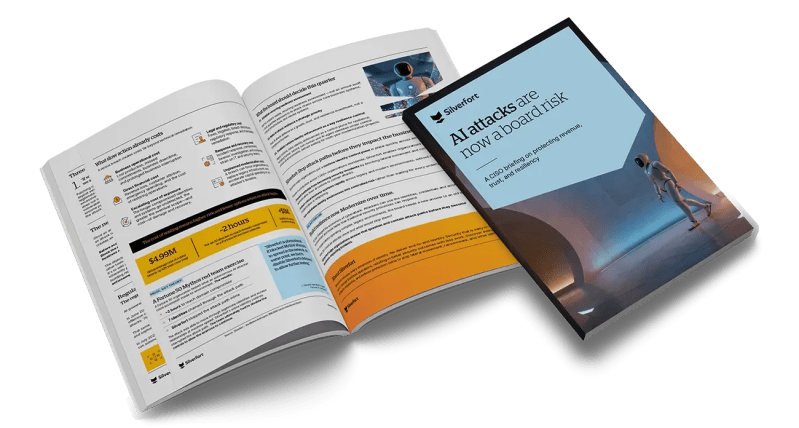
Mythos changed the game. Learn how to win.

Frontier AI models like Anthropic’s Mythos operate at machine speed. Originally designed for advanced cybersecurity research and autonomous penetration testing, these models can also be used to attack or stress-test enterprise environments at a scale and speed defenders can’t match manually 

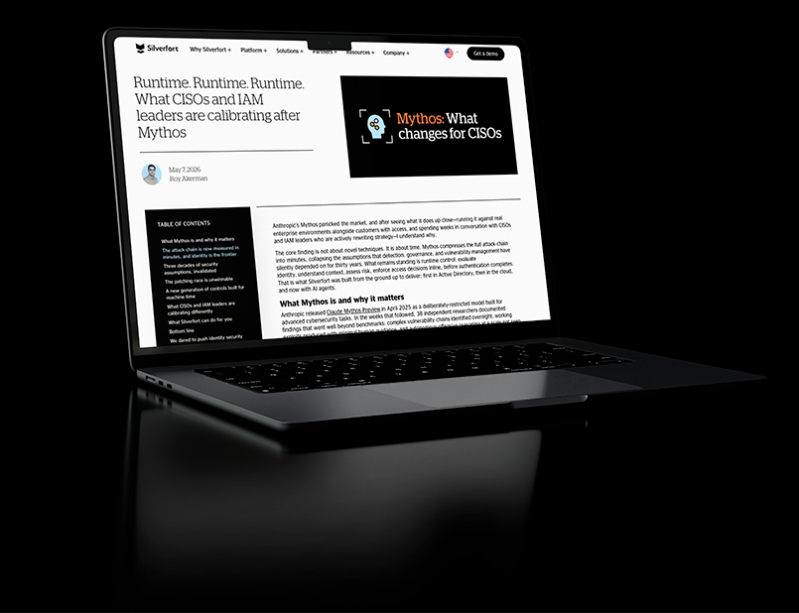
Mac Mythos Laptop mockup

What it takes to stop Frontier AI attacks

Posture improvement, vulnerability patching, and real-time detection won’t stop AI-powered attacks on their own. To face up to machine-speed attacks, you need runtime control over every access transaction—before access is granted.

Legacy-systems-icon-white-bg.svg

A control point on every authentication

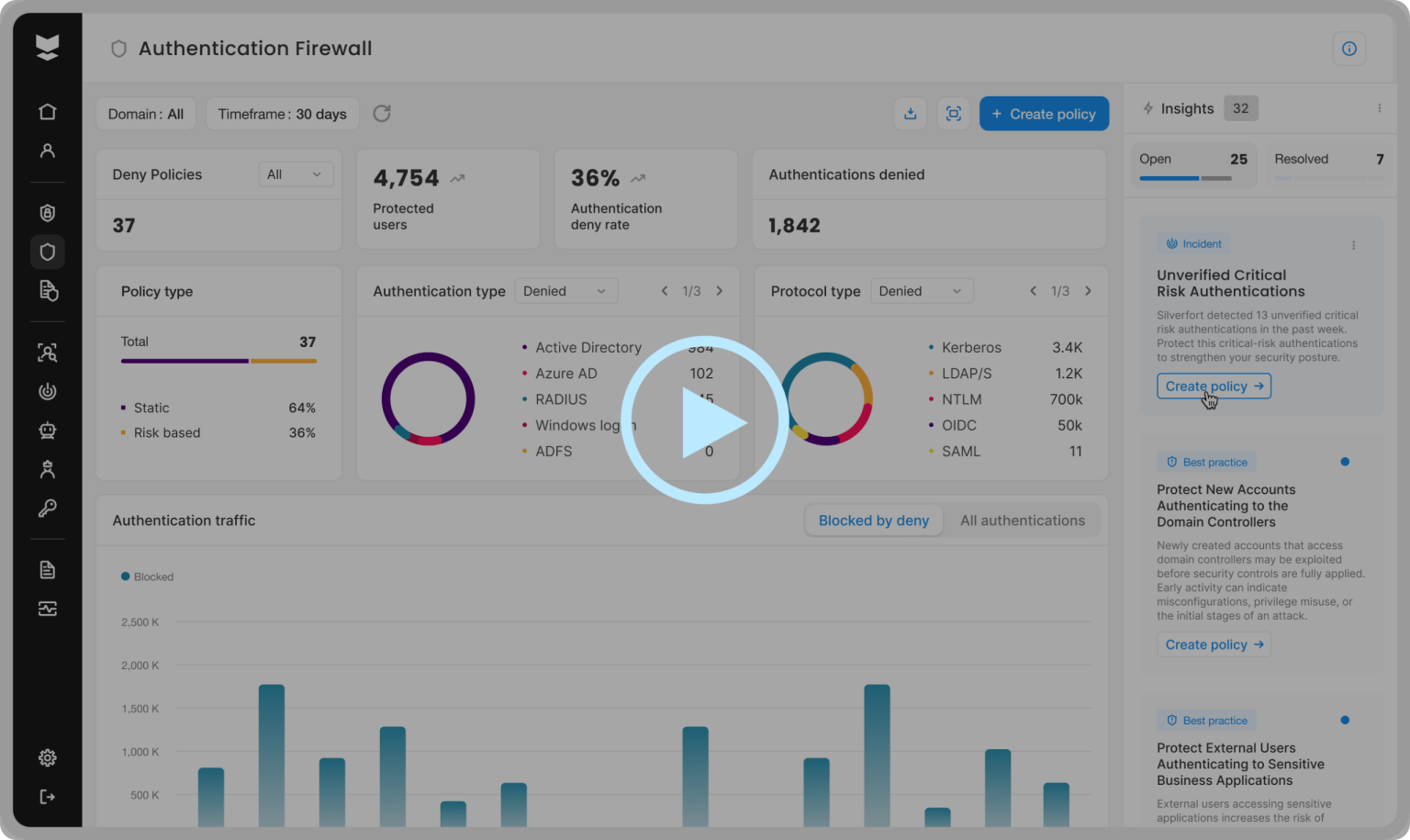
Security must sit inline within the authentication flow itself, evaluating every access request independently based on real-time risk indicators. Controls must be able to allow, block, challenge, monitor, or dynamically restrict access, regardless of existing static policies.

rapid-response-icon-white-bg-1.svg

Intelligent analysis for machine-speed threats

AI-driven attacks evolve dynamically. Effective defense requires continuous risk evaluation using deep identity context, behavioral analytics, environmental signals, and real-time activity to identify malicious patterns before attackers progress.

Resilience Award Icon

Enforcement that operates before the action happens

Detection after execution is too late. Controls must operate early and fast enough to stop the transaction before an AI agent completes lateral movement, privilege escalation, or any other malicious action.

The Silverfort Identity Security Platform

The only platform that stops AI-speed attacks at the identity layer

Silverfort enforces access controls at the moment of authentication, across all identities and all environments. Every request is evaluated in real time, before access is granted.

unmanaged-devices-icon-white-bg

Runtime enforcement across every identity

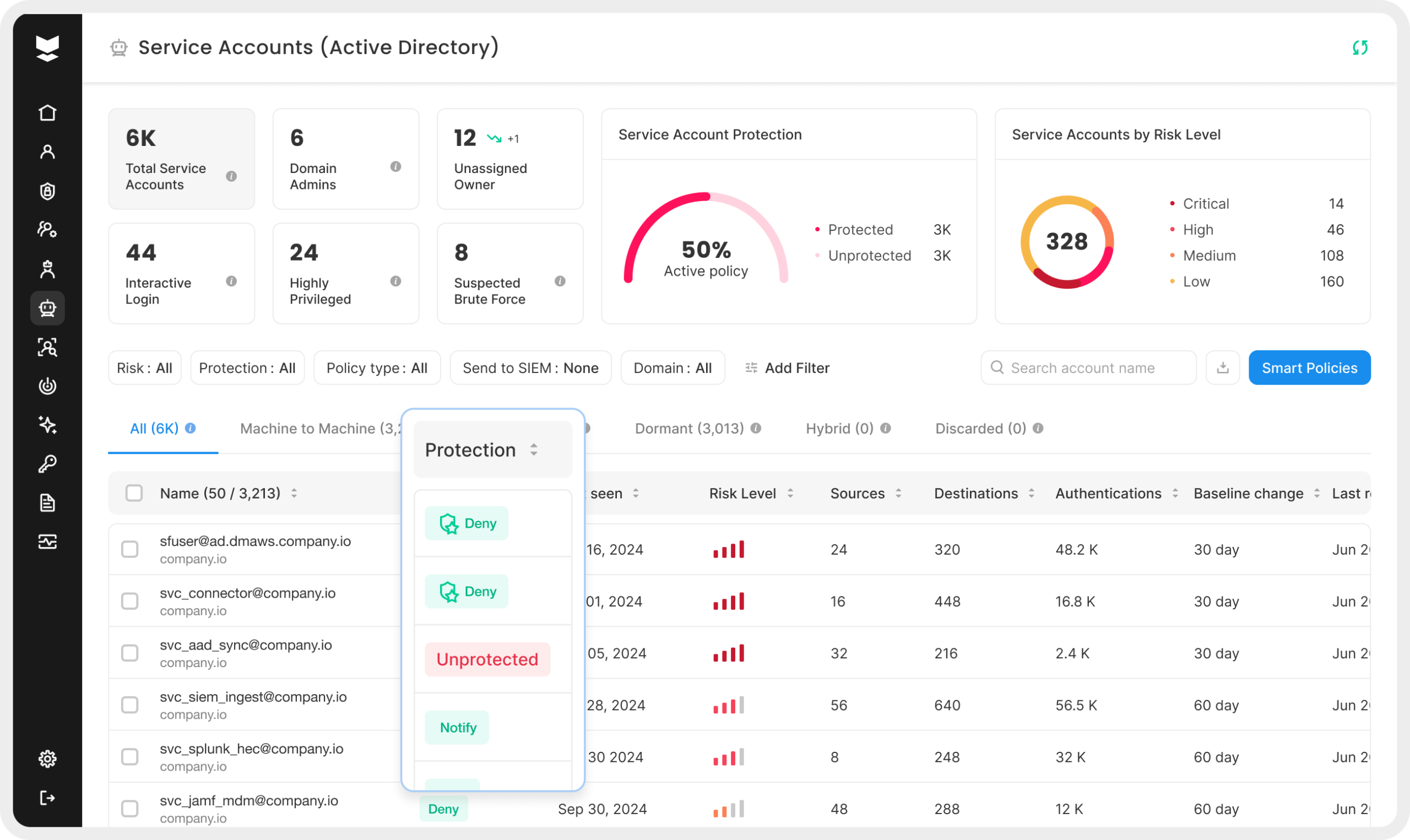
Silverfort applies diverse runtime controls to enforce MFA everywhere, including legacy systems, OT, and CLI tools, block risky access, fence service account activity, limit privileged activity with JIT access, and control AI agent activities.
Speedometer icon

No response window required

Silverfort acts before access is granted, not after an alert is triaged. Block, challenge, or restrict risky access before lateral movement begins and blast radius expands.
Legacy-systems-icon-white-bg-1.svg

Coverage where attackers actually move

Service accounts. NTLM. Legacy applications. OT environments. These are the paths EDR can't see and static PAM doesn't cover. Silverfort enforces controls there too, with no changes to servers, applications, or user behavior.
recharge privilege access icon

AI agents secured as first-class identities

AI agents are treated with the same rigor as human identities. Their actions are monitored, their access is protected, and their behavior can be controlled at runtime through native integrations with leading agentic platforms and an MCP gateway.
service accounts icon white bg

Dynamic decisions, not static rules

Static policies can't anticipate every path an AI model will construct. Silverfort evaluates every access request dynamically and at runtime, based on real-time behavioral context and risk scoring.
Resilience Award Icon

Protection without disruption

Silverfort integrates natively into existing authentication flows with no proxies, network redesigns, application changes, or disruptive infrastructure projects.
unmanaged-devices-icon-white-bg

Runtime enforcement across every identity

Silverfort applies diverse runtime controls to enforce MFA everywhere, including legacy systems, OT, and CLI tools, block risky access, fence service account activity, limit privileged activity with JIT access, and control AI agent activities.
Speedometer icon

No response window required

Silverfort acts before access is granted, not after an alert is triaged. Block, challenge, or restrict risky access before lateral movement begins and blast radius expands.
Legacy-systems-icon-white-bg-1.svg

Coverage where attackers actually move

Service accounts. NTLM. Legacy applications. OT environments. These are the paths EDR can't see and static PAM doesn't cover. Silverfort enforces controls there too, with no changes to servers, applications, or user behavior.
recharge privilege access icon

AI agents secured as first-class identities

AI agents are treated with the same rigor as human identities. Their actions are monitored, their access is protected, and their behavior can be controlled at runtime through native integrations with leading agentic platforms and an MCP gateway.
service accounts icon white bg

Dynamic decisions, not static rules

Static policies can't anticipate every path an AI model will construct. Silverfort evaluates every access request dynamically and at runtime, based on real-time behavioral context and risk scoring.
Resilience Award Icon

Protection without disruption

Silverfort integrates natively into existing authentication flows with no proxies, network redesigns, application changes, or disruptive infrastructure projects.

Don't let AI-speed attacks outrun your defenses.

When attackers operate at machine speed, the only place left to win is at runtime—inside the authentication flow itself.

Stop risky access before it’s granted

Protection controls are built into the authentication flow to stop attackers from moving laterally or escalating privileges.

Reduce blast radius automatically

Dynamically restrict risky access before compromise spreads across identities, systems, and environments.

Innovate without compromise

Secure AI agents and autonomous workflows with runtime controls that scale with the speed of AI adoption.

Fast time to deployment and value

Get up and running in days, with immediate enforcement across your existing identity infrastructure.
Page-gray-frame (1)

See how Silverfort prevents AI-speed attacks from outrunning your defenses.

Auth FW for AD Protection

Learn more

Resource page thumbnail

Mythos, AI-powered attacks and the security reckoning

Abbas Kudrati Blog featured image (1)

Mythos, Spud, and beyond: When AI becomes the world’s best penetration tester

Runtime Mythos Roy blog featured image

Runtime. Runtime. Runtime. What CISOs and IAM leaders are calibrating after Mythos

FAQs

Does Silverfort replace our existing detection and response tools?

No. Silverfort adds the enforcement layer that detection tools cannot provide by acting before access is granted. Silverfort also provides advanced ITDR capabilities to detect identity-based threats across your environment. Your SIEM, XDR, and SOC workflows continue to operate. The difference is that with Silverfort, fewer attacks succeed before those systems need to respond.  

No infrastructure changes are required. Silverfort integrates directly with your existing identity infrastructure — including Active Directory, cloud identity providers (IdPs), PAM solutions, and agentic AI platforms — without modifying servers, applications, or end-user workflows.
This agentless, proxy-free architecture means Silverfort can be deployed across complex hybrid environments at enterprise scale without the disruption and risk of a traditional security implementation.

Yes. Silverfort applies the same runtime identity security controls to non-human identities — service accounts, machine identities, API keys, and AI agents — as it does to human users. This includes complete visibility into NHI activity, continuous risk assessment, and inline access controls that enforce policy at the moment of authentication. As AI agents proliferate across enterprise environments, this capability closes one of the fastest-growing gaps in enterprise identity security: autonomous identities operating outside traditional IAM controls.
Most organizations are up and running within days. Because Silverfort integrates with your existing identity infrastructure rather than replacing it, there’s no rearchitecting, no agent rollout, and no change management overhead. Once connected, Silverfort begins enforcing identity security controls across your environment immediately — covering both human and non-human identities from day one.
Silverfort is purpose-built to stop identity-based attacks — the attack vector behind the majority of enterprise breaches. This includes credential-based attacks such as pass-the-hash, pass-the-ticket, and lateral movement; MFA bypass attempts; privilege escalation; and attacks targeting service accounts and AI agents that traditional MFA cannot reach. By enforcing policy at runtime — at the moment of every authentication request — Silverfort prevents attacks from progressing, rather than detecting them after access has already been granted.
Yes. One of Silverfort’s core capabilities is Universal MFA — extending multi-factor authentication to resources that typically can’t support it, including legacy systems, command-line interfaces, and operational technology (OT) environments. This eliminates authentication blind spots that attackers routinely exploit.

Set up a demo to see the Silverfort Identity Security Platform in action.