The conversation around AI security is fundamentally broken. For the last two years, we’ve obsessed over inputs and outputs: “How do we stop data leakage in prompts?” or “How do we prevent the LLM from hallucinating?” While the industry was busy worrying about what AI says, the technology evolved. We have moved from generative chatbots to autonomous agents. These agents don’t just summarize text; they execute.
When AI moves from suggesting to doing, the risk shifts from a content problem to an access control problem.
That is exactly why we are announcing a landmark native integration with Microsoft Copilot Studio. By bringing inline runtime identity protection directly into the agent’s execution path, we’ve evolved security from a spectator sport into the driver’s seat.
The developer’s dilemma: Speed vs. sovereignty
Microsoft Copilot Studio has democratized autonomy, allowing business teams and developers to build agents that integrate deeply into the core of the enterprise. These agents sit at the intersection of your ERP systems, financial records, and proprietary data.
However, this democratization creates a dangerous “path of least resistance.” For a developer, nothing is easier than granting a new AI agent broad, administrative permissions to “ensure it works” during the build phase. But those over-privileged credentials are the fastest route to a trust-boundary breach.
If your identity controls are weak, every agent built on top of them is an open door. At Silverfort, we believe you shouldn’t have to choose between the speed of AI innovation and the sovereignty of your data.
A deep collaboration for universal Identity Security
As a long–standing Microsoft collaborator and former Microsoft Partner of the Year, Silverfort continues to expand its role in protecting hybrid and cloud environments. Building on this relationship, Silverfort is working closely with Microsoft to deliver deep technical collaboration to help integration and co-innovation across Identity Security. This collaboration helps organizations consolidate identity protection across on-prem, cloud, and hybrid environments by leveraging Microsoft Entra ID as the central control plane for access policies and protection. While Microsoft Entra ID provides world-class protection for cloud-native assets, Silverfort’s patented Runtime Access Protection (RAP) technology extends that protection to all parts of the network and all types of identities.
Together, we provide a unified identity control plane that allows Microsoft customers to apply Zero Trust policies across their entire hybrid estate without the need for complex migrations or manual agent deployments.
Now, we’re expanding this collaboration to future-proof access for the AI era.
A unified strategy for the autonomous enterprise
The new native integration is also a core pillar of Silverfort’s broader strategy to protect AI agents across the entire enterprise ecosystem. It extends the same rigorous protection we pioneered months ago with the introduction of the MCP Gateway, which enforces runtime controls for AI agents as they access legacy systems, private APIs, and sensitive data.
Adding native integrations to control AI agents is more than just an expansion; it creates a unified architecture that delivers deeper coverage, greater scalability, and resilient enforcement across every environment.
This strategy is built on three definitive pillars of AI security:
Pillar 1: Full visibility and “radical human attribution”
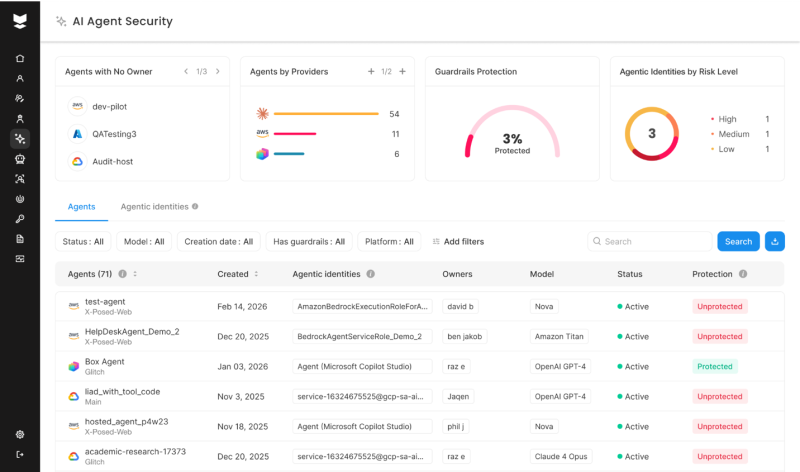
Security starts with discovery. Silverfort automatically identifies AI agents across cloud providers—including Microsoft, AWS, and GCP—and within SaaS environments. This includes the crucial discovery of “shadow” agents built by citizen developers outside of IT’s view.
Every agent is mapped to a human owner, identifying associated non-human identities and connection paths to eliminate “ghost agents.” We call this Radical Human Attribution. Whether the agent acts as an interactive user, a service principal, or via a delegated role, Silverfort maintains a clear “chain of responsibility.” If an agent attempts to access a sensitive SQL database, Silverfort knows exactly which human is accountable for that request.
Pillar 2: AI Security Posture Management (AI-SPM)
Beyond visibility, we provide continuous AI Security Posture Management. Silverfort detects risky agents and exposures, including over-privileged access and supply chain risks. By prioritizing risk based on data sensitivity, exposure levels, and real business impact, security teams gain a clear understanding of an agent’s potential “blast radius” before it turns into an incident. We bring these agents under formal governance without disrupting the developer’s flow.
Pillar 3: Runtime Access Protection (Inline enforcement)
Most critically, we enforce security at runtime, before actions are executed, through a range of inline enforcement points, from MCP gateway to native platform integrations. This is the Silverfort difference: we secure the entire journey instead of just taking the first step.
Every time an agent calls a tool or requests data, Silverfort evaluates the risk in real-time and returns a deterministic decision:
- Allow: The action is within policy and proceeds without friction.
- Block: The action is unauthorized or high-risk and is stopped instantly.
- Step up (coming soon): For sensitive requests, Silverfort will trigger a real-time MFA request to the human owner, asserting human sovereignty over autonomous intent.
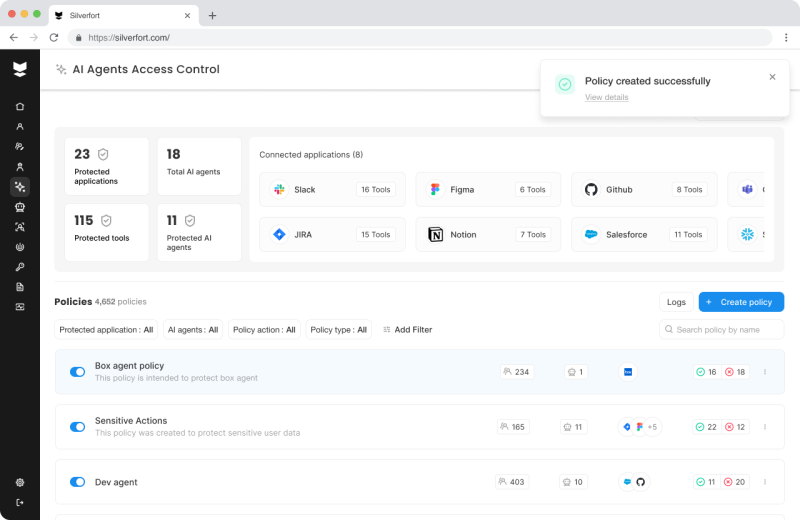
The native integration with Microsoft Copilot Studio enables Silverfort to embed access controls directly into the runtime execution layer. Policies are enforced inline within the platform itself, protecting every tool invocation and data request. Because enforcement is native and inline, it is inherently resilient. There is no proxy to bypass, no dependency on protocols, and no architectural fragility. It scales with the Copilot environment, supporting enterprise workloads and high volumes of agent–driven actions without introducing latency or operational overhead.
Stop worrying about what they say. Control what they do.
By embedding Silverfort’s identity-first control plane directly into the Microsoft Copilot Studio execution path, we connect the dots across your entire environment. By bridging the gap between what you can see and what you can protect, we make sure you can continue to innovate safely.
The future belongs to the autonomous. But it only belongs to the organizations that can control that autonomy before the first API call is made. Silverfort and Microsoft ensure that future remains under your command.
See how to deploy AI agents with confidence, not compromise
Explore ways to scale automation without expanding your attack surface.