Nothing moves faster than AI nowadays. But while we were busy perfecting our prompts, the technology quietly transitioned from answering questions to executing them.
For the last two years, the conversation has been dominated by AI chatbots—reactive tools used to summarize meetings and polish slide decks. We treated them like digital interns, and in that world, the biggest risk was a hallucination or a leaked prompt.
But the “Chatbot Phase” was just the warm-up. The AI model is shifting to something much more powerful.
We have entered the age of autonomous AI agents. These identities don’t just answer, they take action. They are skilled digital employees who can query live databases, trigger workflows, update CRM records, initiate financial approvals, and orchestrate processes across SaaS and cloud environments. They reason, plan, and execute across systems.
What could possibly go wrong?
The performance paradox: Action is the advantage; action is also the risk
In today’s market, organizations that fail to operationalize AI agents, risk being seen as merely “sprinkling AI dust” on existing workflows. However, the competitive advantage of an AI agent lies in its agency: its power to execute tasks without a human pulling the lever. This represents a fundamental change in the security equation. When AI moves from answering to acting, the risk moves from misinformation to unauthorized execution.
Organizations that treat autonomous agents like advanced chatbots are ignoring a critical governance gap and the price of that gap is simply too high.
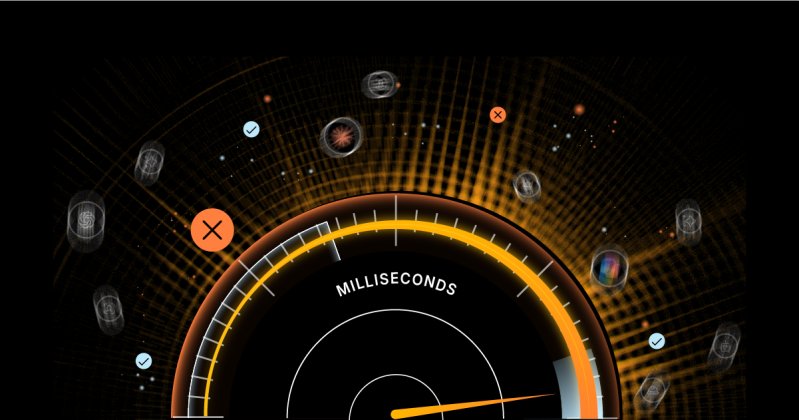
The hard truth: If your security layer can only watch and alert, it is already too late. In the time it takes a human to read a “High Risk” notification, an autonomous agent has already executed a thousand API calls. To secure an agent that acts, you need a security layer that doesn’t only see the agent but can act with it.
The double risk: Cyber attackers and rogue agents
Autonomous AI agents introduce a new, immediate “double risk” that traditional, passive security tools can’t mitigate:
The external threat: Adversarial AI & AI-powered attacks
The first risk is external. Cyber actors are not waiting for you to secure your agents. They are already leveraging AI agents themselves to move faster, all while compromising your agents—abusing their credentials or manipulating their workflows to scale the attack.
This threat has drastically escalated with the advent of frontier model AI-powered attacks, driven by advanced reasoning-focused architectures like Anthropic’s Mythos. In this new era, traditional security paradigms are broken and 0-days don’t matter anymore. Rather than relying on a scarce supply of hoarded, pre-packaged exploits, external attackers use frontier models to autonomously ingest codebases, discover severe vulnerabilities on the fly, and chain them into functional exploits in minutes. These attacks are not static payloads; they are dynamic, adaptive, and reason through a target’s defense architecture at machine speed.
Agents operate using service principals, delegated permissions, API keys, tokens, and non-human identities. If compromised, they become powerful automation weapons for attackers, capable of accessing sensitive systems and executing actions at machine speed. Gartner predicts that through 2029, over 50% of successful cybersecurity attacks against AI agents will exploit access control issues. This is not a “prompt injection” problem, it is an identity problem.
THREAT INTELLIGENCE REPORT
The Mythos Field Report
We saw how Anthropic's Mythos worked its way through real enterprise environments. Read what actually stopped AI-powered attacks.
The internal threat: Exposure by design
The second risk is internal, and just as serious. You no longer need a hacker to have a crisis on your hands. AI agents can create material damage even unintentionally, and without a malicious actor in the mix. Overprivileged access, unclear ownership, lack of lifecycle management, and missing runtime guardrails create exposure by design.
A single misconfigured agent with broad access can unintentionally expose data, trigger unauthorized workflows, or create a cascading operational impact that halts business functions. At lower levels of AI maturity—simple chat interfaces and assistances—this risk is limited. But as companies move into advanced agents that plan multi-step tasks and operate without constant human-in-the-loop checks, the risk increases dramatically. Agent ecosystems that coordinate across multiple applications only multiply that exposure, becoming “black boxes” of operational risk.
In both scenarios, the damage is done before you can even say “Autonomous Agent.”
Identity at runtime: The new execution path
This is not a problem for tomorrow. “Agent sprawl” is happening right now across SaaS platforms, hybrid environments and legacy systems. According to the 2026 Microsoft Cyber Pulse report, over 80% of the Fortune 500 are already deploying active agents.
But most organizations today cannot confidently answer the most basic governance questions:
- How many AI agents are running around in our environment?
- Who owns them?
- What can they access?
- Could you stop them in real-time if you needed to?
Traditional security tools, built for humans or static apps, operate at a “detection-led” speed. They might tell you an agent exfiltrated data, but they often do so ten minutes after it happened.
In the world of autonomous AI, ten minutes is an eternity.
Identity is now the only perimeter left. Because agents operate in the blind spots of traditional security, they often inherit the broad, unmonitored permissions of their creators. This makes visibility alone a secondary goal. To govern AI, enterprise security must move from the sidelines and directly into the runtime execution path. You don’t need a tool that watches what an agent does; you need a control plane that governs its right to act—at runtime.
The future belongs to the autonomous, but only to the organizations that can control that autonomy before the first API call is made.
GUIDE
Secure agentic AI at runtime
Turn AI agent risk into a managed and controlled asset. Get the guide now.