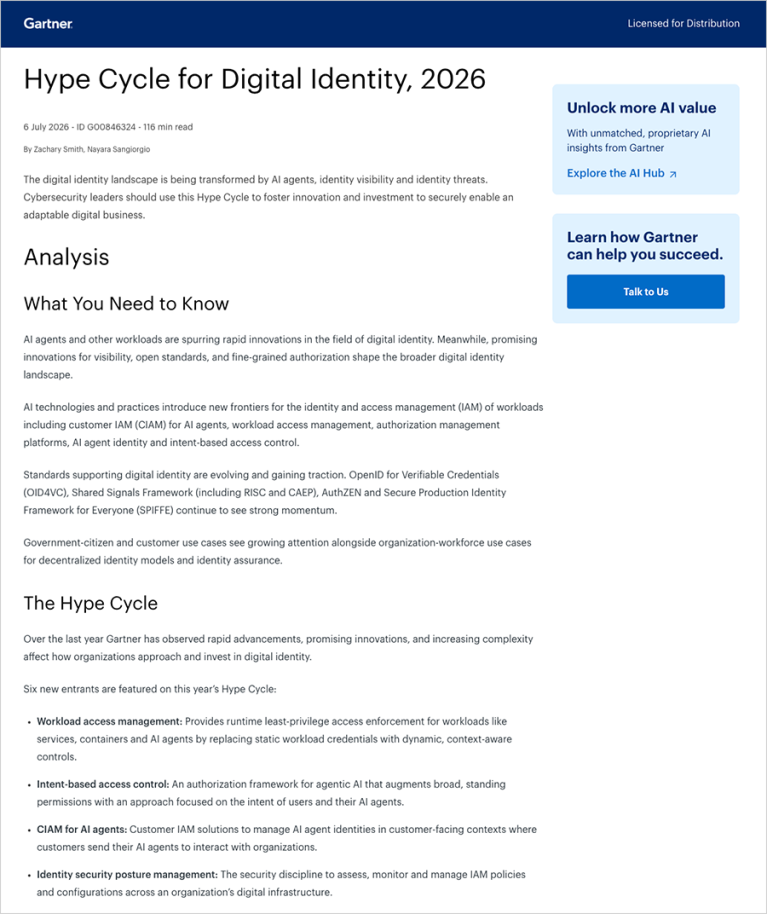
Gartner’s 2026 Hype Cycle for Digital Identity added intent-based access control as a new entry this year—an authorization framework aimed at agentic AI, rated embryonic, with less than 1% market penetration. The first obstacle Gartner lists to adoption isn’t technical. It’s confusion over whose intent is actually being applied: the agent owner’s, IT’s, or the end user’s.
“Agent intent” has become one of those terms everyone in AI security uses and almost no one defines the same way. At Silverfort, we treat it as something concrete; not a vibe, not a marketing phrase, but a specific piece of data with a specific job in the product. This blog lays out what we mean by it, how it connects to access, and how it plays into the way we protect agents at runtime.
Before we start, let’s be clear on how to define “intent.” Gartner’s framing centers on the captured or inferred intent of the human user interacting with an agent. Ours is the agent’s own declared intent—the purpose its builder wrote into it. Both are real controls, and they answer different questions. From here on, it’s declared intent: what it is, what it gets compared against, and what happens when the two don’t match.
Gartner® Report: Hype Cycle™ for Digital Identity, 2026
- How AI agents transform the digital identity landscape
- How to shape security strategy around emerging categories
- Why IVIP, ISPM, & ITDR enable continuous runtime enforcement
1. Declared intent: What the agent says it’s for
Every AI agent, no matter which platform it runs on, is built around a piece of natural-language instructions that tells it what to do. AWS Bedrock calls it an instruction. Google calls it a system instruction. Copilot Studio calls it Instructions. Claude Code calls it CLAUDE.md. Different names, same thing underneath: a human wrote a sentence or a paragraph describing the agent’s purpose, and the platform feeds that text into the agent’s context on every run.
We call this the agent’s Declared Intent: the purpose its builder wrote into its configuration for it to act on.
Two things matter about this definition. First, it’s declared, not verified. It reflects whatever the builder wrote, which might be accurate, might be inaccurate or might be vague.
Second, it already exists. We’re not asking customers to fill out a new form, we’re reading a natural-language field that defines the declared intent, one that already sits inside most agent-building platforms, or inside the agent’s own code.
Our first job is simply to surface it: read the platform-specific instruction fields for each agent, and generate a short, normalized summary of what that agent is declared to do. That gives every agent in the inventory a consistent, plain-English “purpose” line, regardless of which platform built it. On its own, this closes the gap between what the agent builder configured the agent to do and what the identity team reviewing it can see. Declared Intent makes that stated purpose visible and comparable across platforms, so risk assessment starts from the agent’s actual configuration rather than a guess.
2. Scope of access: What the agent can actually reach
Declared intent tells you what an agent is for. It says nothing about what it can do. That’s a separate question, and it’s the one most security tooling has historically focused on: what tools this agent binds to, what data sources can it query, what actions it can take, and what identity or credentials does it inherit to do so.
We call this the agent’s Scope of Access, the sum of its tool bindings, connected systems, and effective permissions, regardless of what it was declared to do. This is the traditional inventory question, and it’s necessary, but it’s incomplete on its own. Knowing that an agent can write to a billing database tells you nothing about whether that’s expected or alarming until you know what the agent is supposed to be doing in the first place.
3. Where intent and access diverge
This is where declared intent stops being a documentation nicety and starts being a security signal. Once you have both a declared intent and a scope of access for the same agent, you can compare them.
A support-triage agent declared to “answer customer questions about order status” that also has write access to a billing database is a mismatch. A document-summarization agent that can make outbound network calls is a mismatch. Neither of these shows up if you only read the declared purpose, and neither shows up if you only look at raw permissions, you need both, side by side, to see it.
We at Silverfort view this divergence as its own class of exposure: access that exceeds what the agent’s stated purpose would reasonably require. It needs to be surfaced in the inventory, prioritized by how far the access exceeds the intent, and handled the way we handle any other exposure, as something to review, right-size, or explain. An agent with no meaningful declared purpose at all, or one whose purpose is too generic to describe anything real, is itself a finding worth flagging, because an unscoped agent is a governance gap on its own.
4. Uncovering the security dissonance: Do the agent’s actions match its purpose?
Intent and access, compared once, gives you a static picture: is this agent over-provisioned relative to what it’s supposed to do. But agents don’t just sit there—they act, continuously, and the real question that matters for protection is dynamic: does this specific action, right now, still line up with what this agent was declared to do, its history, and everything else we know about it?
This is the part of our platform that runs inline in real time, alongside every action an agent takes. Instead of only asking “Is this agent technically permitted to do this,” the protection layer also asks “Is this the kind of thing this agent is supposed to be doing.”
An action that falls squarely inside the agent’s declared purpose and its normal behavioral pattern and established usage profile can be approved with high confidence. An action that diverges—a support-triage agent suddenly attempting a write, a summarization agent reaching out to the network—is exactly the signal that should raise the bar: trigger a human approval step or get revoked outright.
The reason this matters is that an agent going off script isn’t a single kind of problem. It can happen for a lot of different reasons and they don’t all look the same from the outside:
- A malicious or manipulated prompt: someone feeds the agent an instruction it shouldn’t act on.
- A prompt injection: instructions hidden in content the agent reads (a document, a web page, a tool response) that redirects its behavior without the user or operator ever seeing it happen.
- A code or configuration change: the agent’s underlying logic, tools, or permissions changed, intentionally or not, in a way that shifted what it’s now capable of doing.
- A context change: the data or environment the agent is operating in shifted, and it’s now acting on information it wasn’t designed to handle.
- External manipulation: a compromised upstream system, a poisoned data source, or a hijacked identity the agent relies on.
We don’t need to know which of these caused a given action to flag it. That’s the point of comparing the action against declared intent, access, and history rather than trying to diagnose intent or attribute a cause in real time: whatever produced the deviation, a deviation from declared purpose is itself the actionable signal, and it’s one we can catch and act on before we know why it happened.
The agentic intent framework: Connecting visibility, access, and control
Declared intent, scope of access, and actual behavior aren’t three separate features—they’re one continuous thread.

Declared intent starts as a visibility field: what this agent is for. Compared against scope of access, it becomes a baseline for judging whether existing permissions are proportionate: is this agent over-provisioned. Compared against real-time actions, it becomes a live decision input for protection: is this agent still doing what it’s supposed to be doing. Same underlying concept, applied at three different points inventory, exposure detection, and enforcement—giving you one consistent answer to “what is this agent for” instead of three disconnected ones.
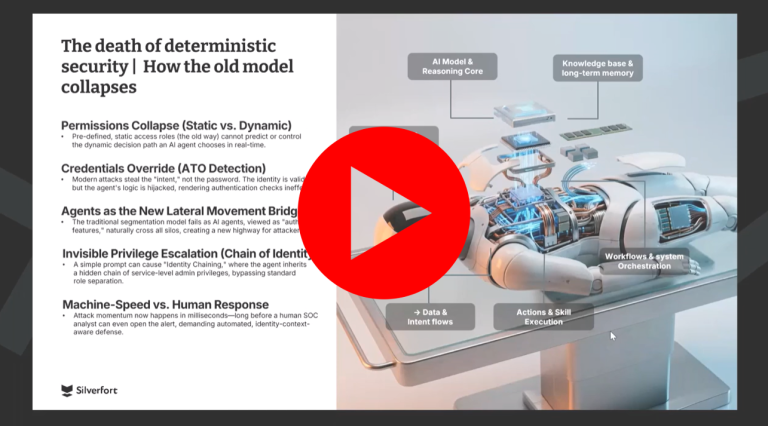
WEBINAR
Learn how to bring the three pillars of agentic AI security together
Silverfort experts explore why traditional IAM, PAM, and deterministic security models break down in agentic AI environments—and what works instead.