
What is AI Agent Security?
AI agent security is the discipline of monitoring and controlling the identities, permissions, and real-time actions of autonomous AI agents so they can only do what they’re authorized to do.
AI agents can now read enterprise data and invoke sensitive tools on behalf of the people who deploy them. Each agent carries an identity, inherits permissions, and acts on its own. Securing it means answering three questions at all times: which agents exist, what can each one access, and who is accountable for it.
This category exists because the identity controls most organizations already run were built for humans logging in, not for software that acts continuously and autonomously. Agents often inherit human-level access and become privileged by design, widening the attack surface for credential abuse and lateral movement. Closing that gap means extending non-human identity security and least privilege to a new kind of powerful actor.
Agents come from across the ecosystem — copilots and autonomous workflows built on platforms like OpenAI, Anthropic, and Microsoft Copilot — and they run in the cloud, in SaaS, and locally on endpoints and developer machines. Effective AI agent security covers all of them, wherever they run and whatever they’re built on.
What makes AI agent security distinct is where control happens. Static access reviews and IAM policies describe intent at admin time, but agents act at runtime – so enforcement has to move to the moment of execution, on every tool call.
Why does AI Agent Security matter?
Security and identity teams face an unprecedented operational reality: AI tools are incredibly easy to spin up, leading to a massive proliferation of shadow agents across cloud instances and SaaS portals without any centralized oversight. Practitioners are left guessing which agents exist, what data they have access to, and who ultimately owns them. Because these tools are routinely granted broad roles or bound to highly privileged service accounts to “just make them work,” a single misconfigured or compromised agent creates a massive, unmanaged blast radius across the enterprise network.
The threat landscape is shifting rapidly to exploit this exact architectural visibility gap.
Gartner expects 40% of enterprise applications to ship with task-specific AI agents by 2026, up from less than 5% in 2025 – and projects that by 2028, a quarter of enterprise breaches will trace back to AI agent abuse. More telling is how those breaches will happen. Gartner also predicts that through 2029, more than half of successful attacks against AI agents will exploit access-control issues, using direct or indirect prompt injection as the vector.
Without dedicated runtime security, a malicious prompt injection or a poisoned integration can hijack a trusted agent’s logic. Because the agent already possesses legitimate, over-permissioned credentials, an attacker can effortlessly execute lateral movement and data exfiltration at machine speed, rendering passive post event monitoring tools completely obsolete.
The pain is real and current: the same autonomy that makes agents useful makes over-privileged access, blind spots, and orphaned credentials a default condition rather than an edge case.
How does AI Agent Security work?
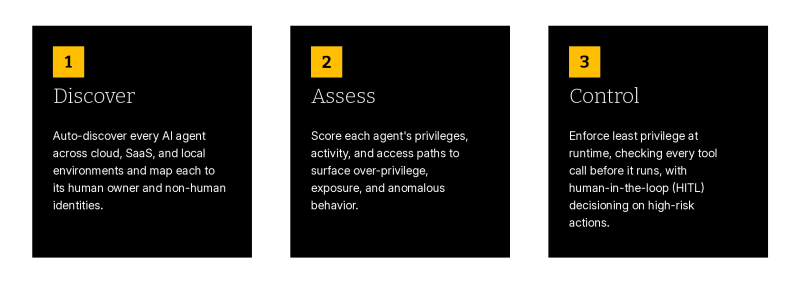
Securing autonomous actors requires a continuous cycle of discovery, identity context enrichment, and inline policy enforcement.
Component | Description |
Discovery and inventory | Continuously find every AI agent across cloud, SaaS, and hybrid environments using read-only API integrations and audit telemetry. Build a live inventory so no agent operates unseen – you can’t govern what you can’t see. |
Ownership and identity mapping | Correlate each agent to its human owner, the consumer who initiates a session, and the non-human identities it uses (an IAM role, service account, or Entra ID application). This ties every agentic action back to an accountable person. |
Posture and risk assessment | Analyze each agent’s privileges, activity, and access paths to surface excessive permissions, exposure, and anomalous behavior, then score and prioritize risk. |
Runtime enforcement | Check each tool call against policy at the moment of execution – through an MCP gateway or native integrations — and enforce least privilege. Permitted actions pass; anything outside the agent’s defined scope is blocked before it reaches the target system. |
AI Agent Security vs. IAM (Identity & Access Management)
Feature | AI Agent Security | IAM (Identity & Access Management |
Focus | Autonomous, dynamic AI actors making real-time, multi-step choices. | Static human workforce users and rigid, predictable machine scripts. |
Scope | Real-time tool calls, API integrations, and chained runtime workflows. | Authentication, initial user provisioning, and role assignment. |
Enforcement approach | Dynamic, inline runtime evaluation – checked on every tool call at the moment of action. | Admin time – static policy and configuration |
Visibility | Live, unified inventory mapping of agents to NHIs, tools and human owners. | Fragmented directory of accounts, roles, and entitlements |
Threat detection | Anomalous agent behavior and over-privilege | Access misconfigurations and policy violations |
Identity coverage | Agents, owners, and the non-human identities they use | Primarily human users and groups |
Compliance reporting | Continuous, auditable tracking of agent ownership, context, and actions | Periodic access reviews and point-intime user privilege reporting. |
Key AI Agent Security capabilities
Securing autonomous actors requires a continuous cycle of discovery, identity context enrichment, and inline policy enforcement.
Capability | What it is | Why it matters | What it does |
Agent discovery | Continuous, API-based detection of AI agents across environments. | You can’t secure agents you don’t know exist. | Builds and maintains a live inventory across AWS, Azure, GCP, Entra ID, and SaaS. |
Ownership mapping | Correlation of each agent to its human owner and non-human identities. | Accountability is impossible without knowing who owns what. | Ties every agentic action back to a named, accountable human. |
Posture management | Ongoing assessment of agent privileges, activity, and risk. | Over-privileged and stale agents are prime targets. | Scores risk and flags excessive permissions and anomalous behavior. |
Runtime enforcement | Policy checks applied at the moment an agent invokes a tool. | Admin-time controls can’t stop an action already in flight. | Allows in-scope tool calls and blocks anything over-privileged. |
Human-in-the-loop approval | A human approves or denies an agent’s high-risk action before it runs. | Some actions are too sensitive to leave to an agent alone. | Pauses a flagged tool call and requires human sign-off before it proceeds. |
AI-in-the-loop decisioning | An AI layer recommends what to allow or block and which policies to build. | Policy at agent scale is more than humans can review by hand. | Surfaces allow/block recommendations and suggested policies for review today, with autonomous enforcement as the next step. |
AI Agent Security use cases
Use case #1: Bring shadow AI agents under control
Agents get deployed across business units and clouds faster than security can track them, leaving an unknown, ungoverned attack surface.
With AI agent security, this looks like:
- Every agent across AWS, Azure, GCP, Entra ID, Anthropic, OpenAI and more is discovered automatically and added to a live inventory.
- Each newly found agent is mapped to a human owner and its associated non-human identities.
- Previously unknown ‘shadow’ agents are surfaced and brought under policy without waiting for a manual audit.
Use case #2: Keep delegated agents inside their scope
An agent acting on a user’s behalf can quietly exceed the rights it was delegated, turning routine automation into privilege escalation.
With AI agent security, this looks like:
- Every tool call is evaluated against the agent’s authorized scope at runtime.
- In-scope actions such as reading a file are permitted while out-of-scope actions such as deleting data are blocked in real time.
- Each action is traceable to the accountable human behind the session.
Use case #3: Harden over-privileged agentic identities
Agents inherit human-level permissions and are privileged by design – an ideal setup for lateral movement if a credential is abused.
With AI agent security, this looks like:
- Excessive privileges and standing access are detected and prioritized by risk.
- Least privilege is applied so each identity keeps only the access it actually uses.
- Anomalous behavior on agentic identities is flagged before it spreads.
Use case #4: Retire stale agents and orphaned credentials
Set-and-forget agents outlive their purpose, leaving valid credentials an attacker can reuse undetected.
With AI agent security, this looks like:
- Inactive and last-activity data is tracked across the agent inventory.
- Stale agents and unused entitlements are identified for decommissioning.
Use case #5: Protect managed AI platforms through native integration
Managed AI platforms such as Microsoft Copilot Studio let agents invoke tools directly, and without a runtime check the platform enforces only its own configuration.
With AI agent security, this looks like:
- A native, API-based integration connects directly to the AI platform — no MCP gateway or agent redirect required.
- When an agent attempts a tool call, the platform requests a real-time ‘second opinion’ from the security layer before the action proceeds.
- The request is evaluated against live identity context and policy, and only in-scope actions are allowed through.
- Enforcement runs transparently in the background, with no SDKs or code changes for developers.
Frequently Asked Questions
What is AI agent security? | AI agent security is the practice of discovering, monitoring, and controlling what autonomous AI agents can access and do. It maps each agent to an accountable human and enforces least privilege on the agent’s actions at runtime, so agents operate only within approved boundaries and companies can innovate safely. |
What is the difference between AI agent security and IAM? | IAM decides who is allowed access and configures it at admin time and are focused on human identities and service accounts. AI agent security controls what autonomous agents actually do and enforces policy at runtime, checking each tool call as the agent acts rather than relying on static configuration. |
What is the difference between AI agent security and non-human identity security? | Non-human identity security covers static machine identities like service accounts and API keys, which typically execute predefined operations. AI agent security covers autonomous actors that reason, make decisions, and delegate tasks to other agents, which requires evaluating intent and behavior at the moment of action, not just checking a credential. |
Why do organizations need AI agent security? | AI agents inherit broad permissions, act autonomously, and are often deployed without a shared inventory or owner. Without runtime control, that creates over-privileged access, blind spots, and orphaned credentials – which is why Gartner projects a quarter of enterprise breaches will trace back to AI agent abuse by 2028. |
How does Silverfort approach AI agent security? | Silverfort extends its identity-first control plane to agentic AI, unifying discovery, visibility, and posture with runtime enforcement. It works through read-only API integrations for discovery and an MCP gateway or native integrations for enforcement, with no SDKs or code changes required. |
AI adoption doesn’t have to widen your attack surface – but it does need controls built for how agents actually behave. With visibility into every agent and enforcement at the moment of action, you can accelerate AI initiatives while keeping access accountable and least-privileged.