Looking for AI agent security? Control what your agents do, without a new tool for every platform.
Most AI agent security tools stop at the agent, enforcing prompt injection, tool calls, or token issuance within their own ecosystem. Silverfort enforces what each agent does at runtime, and protects the human owners, human users, and AD service accounts behind it that the rest of the market can't reach.
- Discover and protect every AI agent, human owner, and service account
- Trace every agent action back to the human who initiated it
- Block risky agent actions inline, or route them for human approval

Why security teams choose Silverfort over siloed AI agent tools
AI agents don’t create a new security problem — they create a much larger version of the one you already have: identities with access. Siloed AI agent security tools come up short in the same three places: what they cover, where their enforcement reaches, and whether they were built for identity in the first place.
See the agent, people, and connections
Agent-only tools inventory the agent and stop there, leaving you unable to answer who’s accountable for it or what it can reach. Silverfort maps each agent to its human owner, invokers, and every identity it authenticates with to protect the people and the AD service accounts behind them.
Three outcomes beat allow or block
Most tools enforce with a hard binary: block too readily and you break a workflow at machine speed, or allow it and hope policy anticipated the situation. Silverfort adds a third path, routing a risky tool call to the agent’s human owner for approval, while protecting the identities on either side of it.
Built for identity, extended to agents
Agent risk is access risk, yet agent security is usually sold as a separate product with its own console, policy model, and owner to manage. Silverfort extends the identity controls already protecting over 1,000 organizations to AI agents, on one policy engine with one audit trail, not a new silo.
How the AI agent security market breaks down
| Vendor category | Examples | What they do well | Where their enforcement stops |
|---|---|---|---|
| AI-runtime enforcement | Zenity, Noma | Inline guardrails inside the agent — prompt injection, data exfiltration, unsafe tool calls and secret exposure blocked deterministically at runtime, within supported platforms | At the agent boundary, and at allow-or-block. No coverage of the humans who own and invoke the agent, and no AD or on-prem reach |
| NHI and agentic access | Oasis, Token, Clutch, Astrix (now Cisco) | Cloud NHI inventory, ownership and lifecycle; just-in-time session identities, intent-aware policy, automated credential revocation and right-sizing. Oasis also escalates to a human on privilege boundaries | At the credential they issue or remediate. Identities they did not provision — AD service accounts, legacy on-prem — fall outside the control point |
| Identity platforms enforcing within their own ecosystem | Okta, Microsoft Entra, SailPoint (incl. Entro) | Issue, govern and certify identities; broker agent tool calls at runtime and gate token issuance with conditional policy | At the edge of the platform. Bound to platform-issued tokens and federated apps |
How Silverfort compares to siloed AI agent security approaches
A side-by-side look at Silverfort against three categories of siloed approaches: AI-runtime tools (Zenity, Noma), NHI and agentic access vendors (Oasis, Token, Clutch, Astrix/Cisco), and identity platforms (Okta, Microsoft Entra, Entro/SailPoint).
| Capability | Silverfort | Siloed Approaches (Zenity, Noma, Oasis, Token, Clutch, Astrix, Okta, Microsoft Entra, SailPoint) | Why It Matters |
|---|---|---|---|
| Agent-layer enforcement, two paths | ✔YesEvery agent tool call is checked against policy before it executes: through native integrations with Microsoft Copilot Studio, AWS, GCP and Anthropic, or through an inline MCP Gateway for agents that do not run on those platforms | ⚠PartialTypically one path only; either a platform-specific integration or a gateway, rarely both | Mixed agent estates need both to close every gap. |
| Human approval in the enforcement path | ✔YesAllow, block or route to human | ✕NoAI-runtime tools are usually allow-or-block | A blunt block on a legitimate action is an outage. Approval turns the hardest policy calls into a decision someone accountable makes in seconds. |
| Protection for the humans behind each agent | ✔YesThe human owner who provisioned the agent and the human users it acts for are protected at the authentication layer on cloud and on-prem | ✕NoOut of scope. Agent security tools secure the agent; the humans on either side of it are not part of the model | An agent is a proxy for a person. Compromise the human who owns or invokes it and the agent becomes the attacker's tool, with every policy still satisfied. |
| AD and on-prem service account coverage | ✔YesBehavioral baseline per account, virtual fencing that blocks unusual source/destination, lateral movement and privilege escalation inline | ✕NoInventory, attribute visibility or secret rotation for AD; no enforcement on AD authentication protocols | AD service accounts are among the most-targeted identities and a top breach vector. Rotating a credential does not stop an attacker already authenticating with it. |
| Agent discovery across environments | ✔YesCloud-based agent platforms, SaaS agents, and local AI agents, spanning Microsoft Copilot Studio, Azure AI Foundry, Amazon Bedrock, GCP Vertex AI, OpenAI, Anthropic, and MCP-based agents | ⚠PartialTypically cloud-first and platform-bound, with limited on-prem coverage | Even cloud-native orgs depend on AD for Windows workloads, M365 and Entra sync, and the fastest-growing blind spot is agents running locally on dev machines. |
| Human-to-agent-to-NHI blast-radius mapping | ✔YesLinks each agent to its human owner, the human who initiated the action, and every NHI it authenticates with, in one view | ⚠PartialPer-identity-type view; agent-to-owner mapping without the underlying NHI chain | You cannot scope an agent's exposure without knowing which credentials it uses and who is accountable for it. |
| Coverage across identity types on one platform | ✔YesAI agents, human users, privileged accounts and service accounts on one policy engine and one audit trail (MFA, PAM, ITDR, ISPM) | ✕NoNHI-only, agent-only, or governance-only | Consolidation cuts tools, data duplication and integration overhead and gives one audit trail across every actor in an agent workflow. |
| Compliance evidence and human oversight (incl. EU AI Act) | ✔YesContinuous, enforced control evidence, plus a real approval checkpoint in front of sensitive agent actions rather than a logged notification | ⚠PartialPoint-in-time posture reporting and audit trails | Frameworks increasingly require demonstrable human oversight of AI, not just a record that something happened. |
| Capability | Silverfort | Siloed Approaches (Zenity, Noma, Oasis, Token, Clutch, Astrix, Okta, Microsoft Entra, SailPoint) |
|---|---|---|
| Agent-layer enforcement, two paths | ✔YesEvery agent tool call is checked against policy before it executes: through native integrations with Microsoft Copilot Studio, AWS, GCP and Anthropic, or through an inline MCP Gateway for agents that do not run on those platforms | ⚠PartialTypically one path only; either a platform-specific integration or a gateway, rarely both |
| Human approval in the enforcement path | ✔YesAllow, block or route to human | ✕NoAI-runtime tools are usually allow-or-block |
| Protection for the humans behind each agent | ✔YesThe human owner who provisioned the agent and the human users it acts for are protected at the authentication layer on cloud and on-prem | ✕NoOut of scope. Agent security tools secure the agent; the humans on either side of it are not part of the model |
| AD and on-prem service account coverage | ✔YesBehavioral baseline per account, virtual fencing that blocks unusual source/destination, lateral movement and privilege escalation inline | ✕NoInventory, attribute visibility or secret rotation for AD; no enforcement on AD authentication protocols |
| Agent discovery across environments | ✔YesCloud-based agent platforms, SaaS agents, and local AI agents, spanning Microsoft Copilot Studio, Azure AI Foundry, Amazon Bedrock, GCP Vertex AI, OpenAI, Anthropic, and MCP-based agents | ⚠PartialTypically cloud-first and platform-bound, with limited on-prem coverage |
| Human-to-agent-to-NHI blast-radius mapping | ✔YesLinks each agent to its human owner, the human who initiated the action, and every NHI it authenticates with, in one view | ⚠PartialPer-identity-type view; agent-to-owner mapping without the underlying NHI chain |
| Coverage across identity types on one platform | ✔YesAI agents, human users, privileged accounts and service accounts on one policy engine and one audit trail (MFA, PAM, ITDR, ISPM) | ✕NoNHI-only, agent-only, or governance-only |
| Compliance evidence and human oversight (incl. EU AI Act) | ✔YesContinuous, enforced control evidence, plus a real approval checkpoint in front of sensitive agent actions rather than a logged notification | ⚠PartialPoint-in-time posture reporting and audit trails |
Enterprises trust Silverfort for AI agent security:
“Silverfort’s approach to securing agentic AI doesn’t stop at discovery and analysis – it also enables inline enforcement to control what AI agents can access at runtime. Plus, it protects human, machine and agentic identities with a single platform, instead of point solutions.”
Steven Rennick,
Senior Leader, IT Architecture, Ciena
“We genuinely weren’t aware of how many AI agents were already running across our environment. Silverfort helped us to discover a large number of AI agents we didn’t know existed and helped us quickly understand what they were accessing and who was responsible for them.”
Lead Platform Engineer,
Global Financial Services Organization
Silverfort AI Agent Security
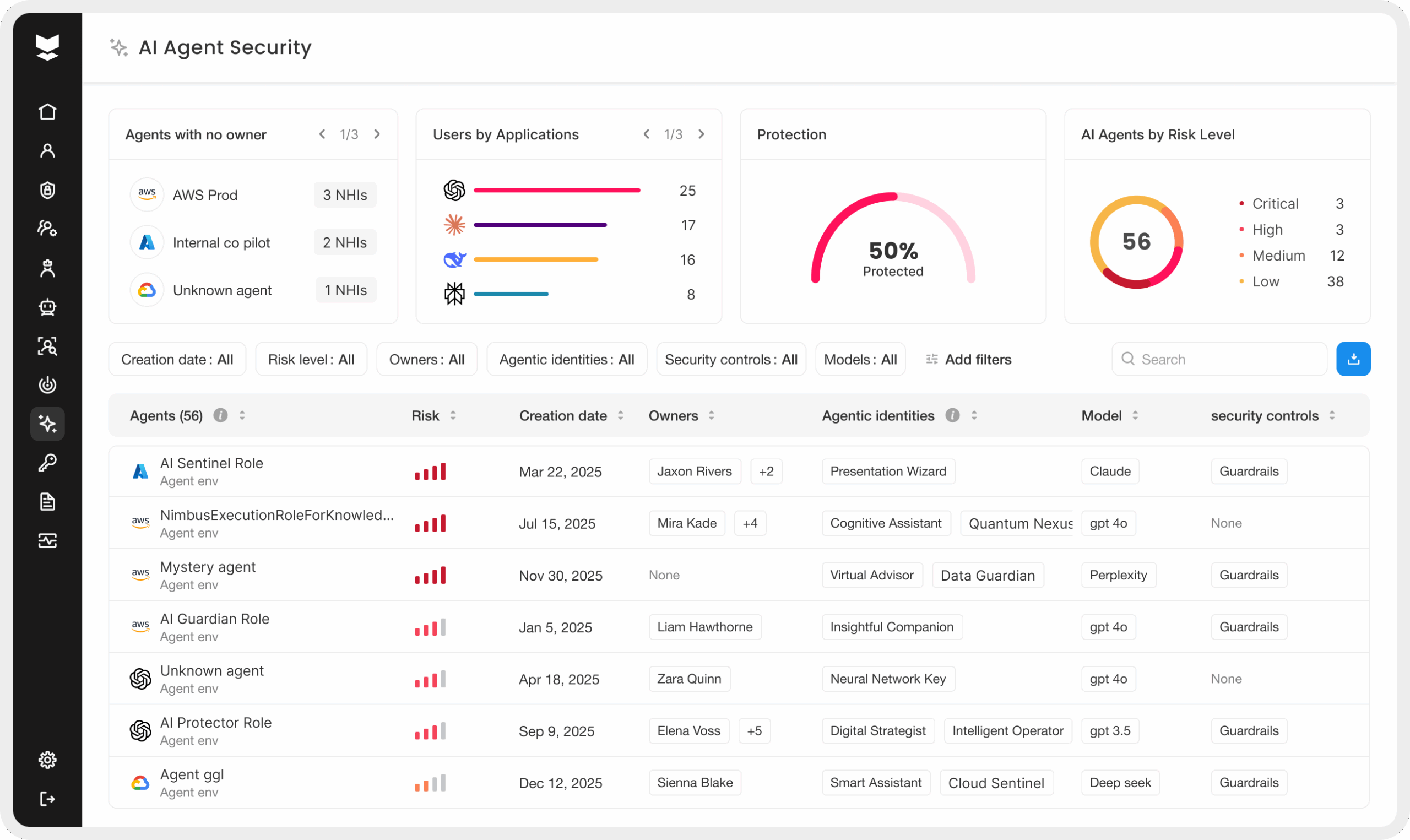
Silverfort is the Identity Security platform that secures every identity type. It discovers AI agents across cloud and on-prem, maps them to their human owner and the identities they depend on, enforces what each agent does at the agent layer, allowing, blocking, or routing actions for approval. No separate point product.
Discover every AI agent and the identities it touches.
Continuously find AI agents across cloud and on-prem, including shadow and locally-running agents, plus the service accounts and users they connect to.
Assess risk and prioritize remediation.
Score each agent’s posture, excessive privileges, orphaned agents, stale credentials, and rank what to fix first.
Enforce what agents do, and protect who’s behind them.
Check every tool call against policy before it executes then allow, block, route it for approval. Apply MFA and access-block policies to the humans and service accounts connected to each agent.
Ready to compare Silverfort against your current stack?
Book a demo with our team, or take a self-guided product tour to see AI Agent Security in action.
FAQs
What is AI agent security?
AI agent security protects AI agents and the identities they use from misuse, compromise, and over-privileged access. Because every agent authenticates with real credentials, securing it is fundamentally an identity problem: discover each agent, understand how it authenticates, and enforce controls on that access in real time. See how Silverfort’s AI Agent Security solution works.
How do you secure AI agents?
Treat agents as identities. Discover every agent, map how it authenticates and who owns it, apply least-privilege access, and enforce controls inline so an out-of-policy action is blocked or sent to a human before it executes. Then protect the human the agent answers to and acts for, since a compromised owner turns it into an attacker’s tool.
How many AI agents do we actually have and how would we find out?
Most teams have more than they think. A short, read-only discovery scan typically surfaces hundreds of unmanaged agents and MCP connections security never knew about, mapped to their humans owners. Microsoft’s 2026 Secure Access Report found 70% of organizations reported incidents tied to AI activity, including agent privilege escalation, and IDC projects 1.15 billion active AI agents by 2029.
Does Silverfort actually block AI agents, or just monitor them?
It blocks, and does more. Every tool call is checked against policy before it executes: on Microsoft Copilot Studio, AWS, GCP and Anthropic through native integrations, and through an inline MCP Gateway for agents that run elsewhere. A call can be allowed, blocked, or routed to the agent’s human owner for approval so an unusual action gets a decision instead of an outage. The human owner and service accounts behind the agent are protected at the authentication layer.
We already have IAM/PAM for our service accounts, do we still need AI agent security?
Yes, and if that PAM is vault-based, the gap is wider than it looks. Vaulting secures the credential, not the action: it was built for human-provisioned accounts with known, static access patterns, while agents spawn dynamically, chain across systems, and act at machine speed. Nothing in a vault decides whether this action, right now, should proceed. Silverfort enforces that at the point the agent acts on the same platform if you already run Silverfort for privileged access.
Can’t cloud security or endpoint platforms like Wiz or CrowdStrike cover AI agents?
No; those tools solve different problems. Cloud security posture tools show you what is exposed, endpoint tools watch device behavior, and identity governance tools manage the identity lifecycle. None evaluate an agent’s tool call before it executes, or the authentication behind it. When an AI agent autonomously triggers an API call or touches a sensitive database, Silverfort is the platform built to ask “should this agent be allowed to do this right now?” and block it if not, at runtime.
Which AI platforms and environments does Silverfort cover, and does it support the MCP standard?
Discovery spans cloud and on-prem, including locally running agents, across Microsoft Copilot Studio, Azure AI Foundry, Amazon Bedrock, GCP Vertex AI, OpenAI, and Anthropic. Enforcement,runs through native platform integrations and an inline MCP Gateway for everything else, with human identities and AD service accounts protected separately, at the authentication layer.
Does Silverfort require agents or application rewrites?
No. Discovery is entirely API-driven with no code changes or agents to deploy. Authentication-layer enforcement evaluates requests in real time without proxies or application rewrites, and fails open so authentication continues if the service is unavailable. MCP enforcement only requires pointing MCP clients at Silverfort’s MCP Gateway URL.
How does Silverfort compare to AI-runtime security tools like Zenity and Noma?
Zenity and Noma enforce inside the agent, inspecting prompts and tool calls at runtime within the platforms they integrate with, but their verdict is allow or block, and their model stops at the agent. Silverfort checks tool calls inline too, adds human approval as a third outcome, and covers the human owner andAD service accounts behind the agent.
How does Silverfort compare to NHI and agentic access vendors like Oasis, Token, and Clutch?
Oasis issues just-in-time session identities, and Token and Clutch automate credential revocation and right-sizing. If cloud NHI lifecycle governance is what you need, that’s what they’re built for. Silverfort solves a different problem on the same estate: enforcing what agent does at the moment it acts, and protecting the human owner and AD service accounts these platforms don’t provision.
How does Silverfort compare to Okta for agent identities?
Okta Agent Gateway routes agent tool calls through Okta policy, which is real enforcement, but it covers only the tokens Okta mints and the apps it federates. Silverfort enforces agent tool calls through its own gateway and native integrations, adds human approval as a third outcome, and protects the human identities and AD service accounts Okta’s enforcement never reaches. It integrates with Okta rather than replacing it.
How does Silverfort compare to SailPoint for agent identities?
SailPoint’s Agentic Fabric, now including Entro, adds real-time controls for non-human identities within SailPoint’s governance model. The limit is reach: enforcement covers the identities SailPoint provisions and governs. Silverfort enforces each agent’s tool calls directly, routes sensitive ones to a human, and protects the AD service accounts and Kerberos, NTLM, and LDAP traffic SailPoint’s model doesn’t reach.
How does Silverfort compare to Microsoft Entra for agent identities?
Entra Agent ID gives each agent an identity, and Conditional Access for Agents can block its authorization request before it connects, real enforcement, but Microsoft describes it as a lightweight control centered on Microsoft-issued tokens. It governs the identity Entra issued, not what the agent does with it. Silverfort checks each tool call before it executes and protects the human owners and AD service accounts behind it.
Cisco acquired Astrix, doesn’t that make agent security part of the network stack?
Cisco closed the Astrix acquisition in June 2026 and is folding it into Cisco Identity Intelligence, Duo and Secure Access, a real signal that agent identity is platform territory now. What it inherits is Astrix’s cloud NHI scope: OAuth tokens, API keys and SaaS integrations. It doesn’t enforcement on what an agent does at runtime, or on the AD identities behind it. Silverfort integrates with Duo and complements that stack.
Does Silverfort help with AI compliance, including the EU AI Act?
Yes. Silverfort discovers which agents touch high-risk functions, provides enforced rather than point-in-time evidence that controls are applied, and puts a real approval checkpoint in front of sensitive actions: a named human authorizing it before it executes, not a notification after. That supports ongoing risk-management and human-oversight obligations under frameworks such as the EU AI Act.