
Protecting privileged identities remains one of the biggest security challenges organizations face today. Yet, it’s time we admit it: the approach taken to solve this problem for nearly three decades has utterly failed.
IAM teams were driven to buy tools that were supposed to protect them. In practice, they only gained a false sense of security.
Customers we speak with tell us the same story: millions spent on PAM solutions, only to protect a few hundred accounts, at most. Add to that the never-ending deployment journeys, the onboarding effort that never quite finishes, and the overhead required to maintain PAM solutions—and you’ve landed the perfect recipe for frustration.
Why traditional PAM failed
At their core, traditional PAM solutions are built with a logic failure: they protect credentials, not access.
Twenty-five years ago, when PAM originated, that might have been enough. There were a few human administrators, and relatively simple environments. Protect the password, hide it behind a vault, and force users to retrieve it—problem solved.
That world no longer exists.
Today, with thousands of privileged identities, most of them non-human, onboarding them into a vault and rotating passwords is unsustainable. Worse, it creates massive business disruptions. Human admins find ways to bypass controls in order to avoid lengthy workflows. Password rotations create operational friction, and since vaults can’t surface dependencies, teams are effectively flying blind. After months of effort to onboard a single account, you still don’t know what will fail the moment it’s vaulted and rotated.
In an imaginative world, if no user would ever check out credentials stored in a vault, PAM could make sense. In reality, credentials are extracted, passwords are not being rotated often enough, and protection becomes a vanity metric.
PAM security becomes bluff security.
This isn’t hypothetical. Attackers routinely exploit credentials stored outside of vaults and use them with no other layer of protection.
The infamous 2017 Uber breach is just one example: attackers used stolen credentials to access a private GitHub repository, where hard-coded AWS keys were discovered. Those keys provided access to Uber’s cloud storage, exposing millions of users’ and drivers’ personal data.
There’s no softer way to say it: PAM does not protect privileged access.
The tragedy of IAM teams
This old paradigm led to a grim situation where identity teams became everyone’s favorite team to hate. Unwillingly fighting futile battles, wasting months or years of red tape and resources to get to a dead-end. A chronicle of a failure foretold.
With traditional PAM, IAM leaders often found themselves unable to get projects to the finish line. And by the time some progress was made, the environment had already changed, the scope of audits shifted, and systems evolved.
To compensate for built-in limitations, more features have been developed to try and solve these critical security gaps.
Session recording is one example. Organizations were driven to check the compliance box, just to be left with thousands of hours of recordings no one will ever watch. Real security still wasn’t achieved, but enterprises found themselves deepening their lock-in to PAM.
Professional services followed, designed to “rescue” failing deployments. More spending. More time. Minimal change.
Why traditional PAM has no future
The first generation of PAM companies emerged more than 25 years ago. In technology lifespans, that’s practically an eternity.
Think about how much has changed since then. It was a world with no Spotify, Google Maps, or smartphones. Music came from CDs or Walkmans. Navigation meant paper maps. Photos required film rolls and days of development. Data lived on physical servers. Payments were cash or card swipes with signatures—not contactless taps and biometric authentication.
In a world where technology evolves so rapidly, it’s inevitable that PAM will evolve, too.
Just as McAfee and Symantec were the first-gen endpoint security companies that laid foundations for a newer generation to innovate, first-gen PAM solutions are living their final chapters. While they addressed a true need three decades ago, their solution belongs to a different era.
Naturally, they’re not giving up easily. Over the years, they drove regulations that obligate companies to adhere and implement tools proving little security value. But there’s no reason to continue driving down that road.
We see cyber insurance companies already realizing change. With financial motivation to reduce claims, they’ve started to incentivize controls that reduce risk, not just satisfy checklists. I have no doubt that regulations will follow.
Change is inevitable, now more than ever
If you ask me why I’m so sure we’ve reached an inflection point, I’d argue that technological shifts are deepening the problem on one hand—and offering a solution on the other.
In today’s modern IT environments, privileged accounts are no longer a small group of trusted administrators. They’re vastly outnumbered by NHIs and AI Agents created continuously and at scale. Recent research estimates ratios ranging from 45 to 80 non-human identities for every human user.
Systems are changing, environments are no longer solely on-prem, but rather hybrid and multi-cloud. Applications multiply by the day, accessed by automated privileged identities. This growth is exponential.
If anything has become clear, is that protecting credentials is not enough. The only thing that matters is protecting access.
Only by consistently managing and enforcing what the account does, with granular dynamic policies on the authentication layer, real privileged access security can be achieved.
The future of PAM is vaultless
Luckily, today’s technology enables a fundamentally different approach: continuous runtime enforcement for every access attempt.
With Just-in-Time and Just-Enough Access, credentials are valid only when needed, and only for their intended purpose. Risk-based policies apply every time credentials are used. And unlike a vault, enforcement cannot be bypassed—even if an attacker obtains legitimate credentials.
The same applies for AI agents that were just created. Modern technology allows us to instantly analyze what any privileged identity is doing in real time and make continuous decisions to ensure privilege serves its purpose.
With these learnings in mind, we’ve designed our Vaultless PAM approach.
Based on innovative technology that allows us to analyze every access attempt—on-prem and in the cloud, we can enforce protection inline, at runtime, everywhere.
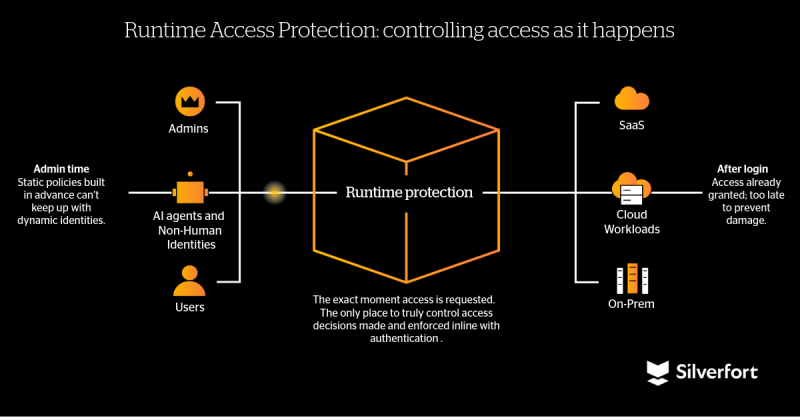
What this means for identity and security teams:
- Fast, scalable deployment: no internal politics, no need to advocate with each app owner to onboard a single admin. Immediate Time-to-Value.
- Strong protection, without the friction: no broken scripts or disruptive password rotations. A shift from password protection to access protection.
- Discovery made easy: privileged accounts are not confined to the ones vaulted. Each identity is classified based on its behavior, even if you don’t know it exists. A human or machine identity attempting to access domain controls or privileged resources is automatically considered privileged and secured as such.
- End-to-end visibility: no more guesswork and blind spots. Finally, a single view of all access in your environments: who attempts to access what, when, and under what risk conditions. This applies for admins, Tier-0 and break glass accounts, but also to machines (service accounts, AI Agents and other NHIs).
- Good user experience: no more forcing admins into vault workflows dozens of times per day. Instead of re-educating the org, security operates seamlessly in the background.
- Security for every identity: even ones that were just created, at runtime. Now, there’s a solution that fits the dynamic enterprise environment: secure, dynamic, frictionless.
For organizations with existing PAM, especially in regulated industries, Silverfort’s Identity Security Platform can start where your PAM got stuck and help you quickly reach privileged protection without discarding prior investments. Simply gain full visibility to all privileged identities and bring the same level of protection to all, anywhere.
For organizations without PAM, Silverfort delivers PAM-level protection without vaults, agents, or workflow disruption. Customers get real privileged access security without taking on the cost, risk, and operational burden of a traditional PAM program.
The market is desperate for innovation. Identity Security teams don’t need to carry the weight of outdated architecture. They can stop fighting windmills—and return to what really matters: protecting access within their organization.
Want to learn more about how Silverfort protects privileged access at scale? Take a tour of our platform.