
The Gartner® 2026 Hype Cycle™ for Digital Identity explains how “The digital identity landscape is being transformed by AI agents, identity visibility and identity threats. Cybersecurity leaders should use this Hype Cycle to foster innovation and investment to securely enable an adaptable digital business.” In our opinion, this year’s report spans the full range—from emerging categories built around AI agents and workloads to disciplines like Identity Threat Detection and Response (ITDR) that have already proven themselves in the market.
In this post, we’ll break down our three key takeaways from the report. The clearest one: Identity Security is converging.
Visibility, posture management, and threat detection are consolidating into a single see → harden → detect and stop lifecycle—a shift that matters when two out of the top four initial access vectors (phishing and credential abuse) are identity-related exploits (Source: Verizon’s 2026 Data Breach Investigations Report). We’ll also show where Silverfort was recognized, named as a Sample Vendor in IVIP, ISPM, and ITDR.
Prefer to start with the research? Download the Gartner Hype Cycle for Digital Identity, 2026.
Gartner Hype Cycle for Digital Identity 2026 report: Our key takeaways at a glance
- Unified visibility is required to take action on enforcing security policy at runtime: IVIP is the foundation that allows security teams to enforce security at runtime, and it works best when part of a complete platform approach paired with ISPM and ITDR capabilities.
- The next frontier is non-human: AI agents and workloads are the fastest-arriving new categories in digital identity.
- Identity Threat Detection and Response (ITDR) benefits empower security and IAM teams to unite together.
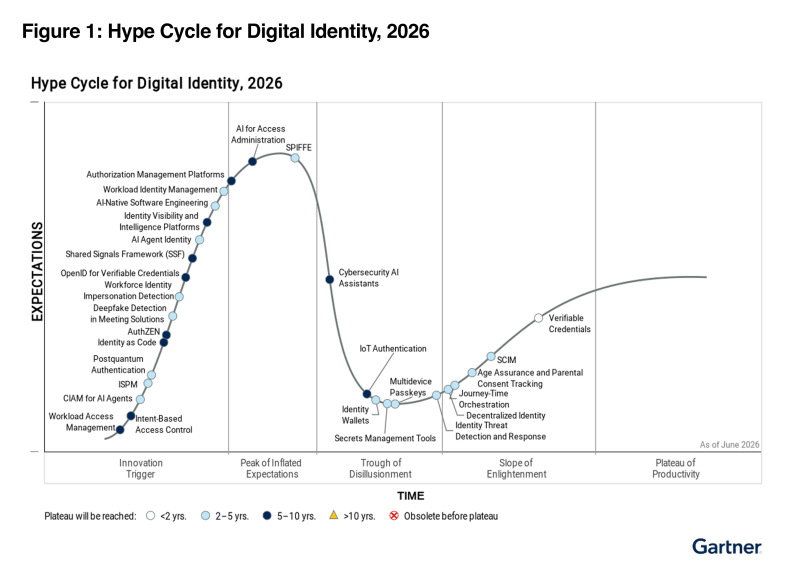
Unified visibility and intelligence are required to act and enforce policy
IVIP → ISPM → ITDR. On the curve, both IVIP and ISPM are in the Innovation Trigger phase, signaling that these categories are growing in interest. Meanwhile, ITDR is more widely adopted, quickly approaching the Slope of Enlightenment.
One detail that could be easy to gloss over unless analyzed further is the fact that IVIP sits further along the curve than ISPM, despite IVIP being a newer category introduced in 2025. We don’t find this to be a coincidence, and here’s why:
- See it—Identity Visibility and Intelligence Platforms (IVIP): Unified visibility and intelligence across every identity and its access.
- Secure it—Identity Security Posture Management (ISPM): Measuring identity risk and hardening posture and policy.
- Stop it—Identity Threat Detection and Response (ITDR): Detecting and responding to identity-based attacks in progress.
If your visibility doesn’t span all identities in your hybrid infrastructure, you don’t have the context to take the right action, whether that’s stopping an attacker with runtime controls or allowing an AI-in-the-loop decisioning engine to help determine the right policy. Posture and detection tools don’t share the same contextualized identity data to help your team make high-fidelity access decisions. Instead, you’re left with seams—the gaps that make lateral and vertical movement and privilege escalation much easier to accomplish and harder to detect.
The need for unified visibility and context as the foundation is further validated by one of the new categories in this year’s report: Intent-based access control. Gartner defines this as:
“Intent-based access control is an emerging authorization framework that replaces broad, standing permissions and is currently targeted at agentic AI, but offers broad applicability. Intent-based access control grants access to back-end resources based on the captured or inferred intent of users interacting with an agent and evaluates the agent’s intended actions against that intent.”
Then, with IVIP as the contextual layer, these categories side-by-side – IVIP, ISPM, and ITDR – work best when they feed one another in an end-to-end, Runtime Identity Security platform.
The non-human security era: AI agent and workload identity
If you’re reading the curve for direction, watch where the newest categories cluster: around machine and AI identity.
AI Agent Identity
Governed identities are established for AI agents, with scoped credentials, clear ownership, and audit trails, rather than reused human logins. We feel Gartner frames this as foundational to scaling agentic AI safely.
Workload Identity Management (WIM)
Workload identities (service accounts, containers, and increasingly AI agents), are discovered, inventoried, and governed at a pace we feel Gartner notes outstrips human identities.
Workload Access Management (WAM)
What a workload is permitted to do is governed dynamically, at runtime, replacing long-lived static credentials with dynamic, context-aware access.
None of these are mainstream yet—but for a leader setting up a multi-year strategy, they signal where the identity problem is heading. Non-human and AI identities are multiplying faster than any team can govern manually, and the organizations building them into the plan now will avoid a scramble later.
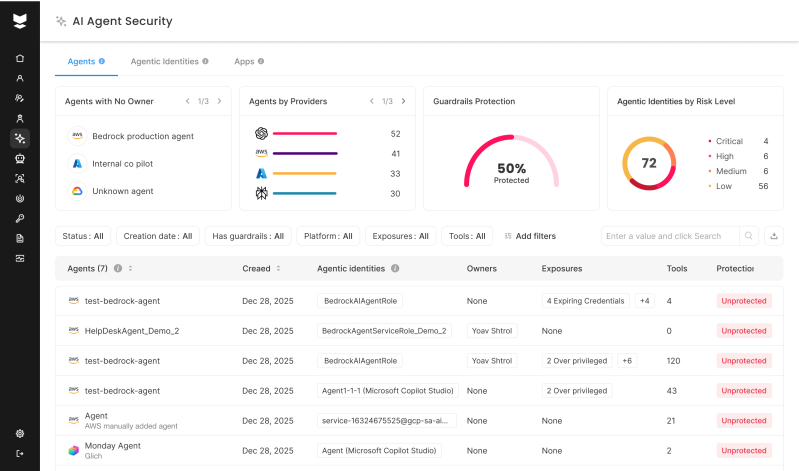
This is the gap Silverfort’s AI Agent Security capability is built to close: every agent automatically tied to a human owner and the NHIs that power its actions, with controls enforced at the moment a tool call executes, and all under one policy engine.
Identity Threat Detection and Response (ITDR) is a driver for uniting the security and IAM functions
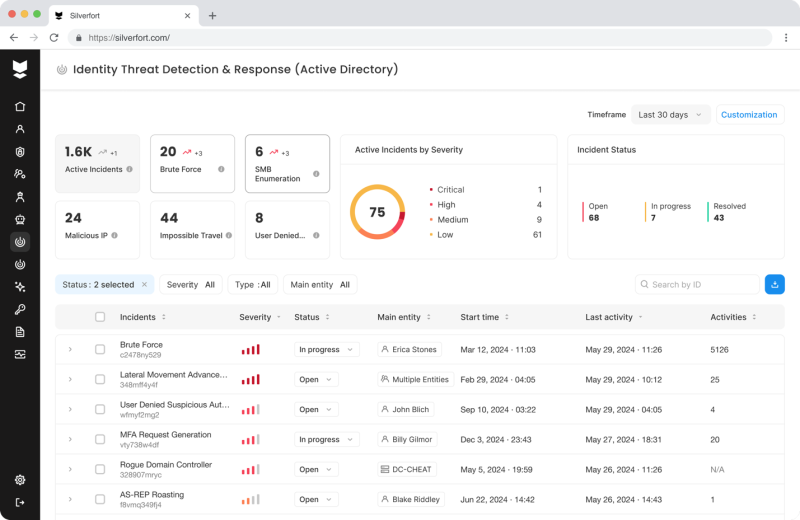
ITDR is climbing out of the Trough of Disillusionment with market penetration above 50%, and it is poised to reach the Slope of Enlightenment. The benefits have become clear. Most IAM tools “have major detection gaps,” as analyst Mary Ruddy notes (82). The SOC has traditionally relied on SIEM platforms, where identity data is difficult to comb through and alerts are buried in the noise.
But detection alone is not the finish line. In our opinion, Gartner observes that detection now outpaces containment. Teams can see an attack without being able to stop it fast enough. The ITDR that reaches the Slope of Enlightenment is the one that can act on what it detects, in real time. That is the difference between an alert and a stopped attack: a decision rendered at the point of authentication rather than after access has already been granted.
Additionally, 39% of identity security decision makers report that security incidents and breaches are their top concern when managing workforce identities. The disconnect between IAM and the SOC has never been easier to pinpoint, not only because of the tools each team works in every day but also because of their different mandates. ITDR gives the two functions a shared surface to work from and a common set of goals.
In practice, an ITDR that brings identity and security teams together combines three core capabilities: see, spot, and stop.
Monitoring authentication and access activity: See every authentication
Every authentication and access request is tracked across cloud IdPs, SaaS apps, on-prem directories, and the legacy systems, service accounts, and non-human identities other tools can’t reach. That coverage is what makes it possible to spot credential misuse, anomalous access, and lateral movement even when attackers switch usernames.
Correlating identity activity across hybrid Systems: Spot the malicious access
Identity activity is correlated across hybrid environments into high-confidence, MITRE ATT&CK-aligned incidents, not more alert noise, so SOC teams can understand impact, prioritize response, and investigate in minutes instead of hours.
Stop the attack in real time
A real-time allow-or-deny decision is rendered inside the authentication itself, stopping the attack inline before access is granted by triggering MFA, denying access, or terminating the session on the paths no other ITDR can enforce inline: Kerberos, NTLM, LDAP, service accounts, file shares, legacy systems, and NHIs. Others only alert; Silverfort acts. Enriched identity context streams to SIEM, SOAR, and XDR so SecOps gets the high-fidelity data it needs to respond fast.
What the state of digital identity means for security leaders
If you own Identity Security risk, three moves follow from this year’s report:
- The non-human and agentic workforce are where to plan for next. You’ve already heard it heating up in the last few years: non-human identities far outnumber humans in the organization, and with every new AI agent, more NHIs spawn. In fact, Microsoft Security Research predicts that businesses will deploy over 1.3 billion AI agents by 2028, signaling that the time to make sense of the AI Agent Security landscape is now.
- IVIP, while a new category, is already fast approaching the next phase on the curve. The intelligence layer for visibility is the foundation of any mature Identity Security program. It isn’t enough to just know what identities exist—understanding the relationships of how all your identities weave together throughout your entire IAM infrastructure is needed to create an action plan based on your organization’s unique environment.
- Build for convergence, not the individual capabilities. Patching together separate tools is exactly what attackers hope you’ll do. Fragmentation causes blind spots, making it harder to implement the “see → harden → detect and stop” lifecycle at runtime for every identity.
Read the full analysis in the 2026 Gartner Hype Cycle for Digital Identity.
Frequently asked questions
What is the Gartner Hype Cycle for Digital Identity and how do the phases work?
“The digital identity landscape is being transformed by AI agents, identity visibility and identity threats. Cybersecurity leaders should use this Hype Cycle to foster innovation and investment to securely enable an adaptable digital business.” As you read the analysis, we feel it’s important to remember that position on the curve reflects maturity. For example, a category on the Innovation Trigger isn’t unproven; it’s early, with value being more obvious at a later point in time. One on the Slope of Enlightenment isn’t past its prime; it’s battle-tested.
Which categories is Silverfort named in on the 2026 Hype Cycle for Digital Identity?
Silverfort is listed as a Sample Vendor in three profiles: Identity Threat Detection and Response (ITDR), Identity Security Posture Management (ISPM), and Identity Visibility and Intelligence Platforms (IVIP).
What does being named as a Sample Vendor mean?
Sample Vendors are a representative, non-exhaustive list of providers active in a category. Gartner does not endorse any vendor, product or service depicted in its research and does not advise technology users to select only the vendors with the highest ratings or other designation.
What is the difference between ITDR, ISPM, and IVIP?
IVIP is unified visibility into identities and their access; ISPM is measuring and reducing identity risk (posture); ITDR is detecting and responding to active identity-based attacks. Together they form a “see → harden → detect” lifecycle.
What is the difference between Workload Identity Management and Workload Access Management?
In short: one answers “what workload identities exist and who owns them,” while the other answers “what can this workload do right now.” Workload Identity Management is about discovery and governance, finding, inventorying, and managing the identities behind service accounts, containers, and AI agents, categories are growing faster than human identities. Workload Access Management is about runtime control, governing what a workload is actually permitted to do in the moment, replacing long-lived static credentials with dynamic, context-aware access decisions.
Why does appearing in three categories matter to us?
The three placements span nearly the full maturity curve and map to the entire identity security lifecycle—a signal of a platform approach rather than a single-purpose point tool, at a moment when the market is converging on exactly that.
See where you stand across all three. Get a demo of the Silverfort Identity Security Platform.
Gartner disclaimer. GARTNER and HYPE CYCLE are registered trademarks and service marks of Gartner, Inc. and/or its affiliates in the U.S. and internationally and are used herein with permission. All rights reserved. Gartner does not endorse any vendor, product or service depicted in its research publications and does not advise technology users to select only those vendors with the highest ratings or other designation. Gartner research publications consist of the opinions of Gartner’s research organization and should not be construed as statements of fact. Gartner disclaims all warranties, expressed or implied, with respect to this research, including any warranties of merchantability or fitness for a particular purpose.
This graphic was published by Gartner, Inc. as part of a larger research document and should be evaluated in the context of the entire document. The Gartner document is available upon request from [insert client name or reprint URL].
Source: Gartner, “Hype Cycle for Digital Identity, 2026,” Zachary Smith, Nayara Sangiorgio, 6 July 2026.