
CISO Brief: Why AI attacks are now a board risk
The economics of cyberattacks have changed. AI-powered attackers can discover risk faster, adapt continuously, and pursue multiple attack paths in parallel, often using legitimate credentials and privileges rather than exploiting a new vulnerability at every step.
That changes the question CISOs need to answer. As AI makes footholds faster and more likely, they need to know how far an attacker can go once they do, and whether a foothold can be contained. For most enterprises, running Active Directory, legacy systems, and homegrown apps that can’t be modernized overnight, that question is urgent.
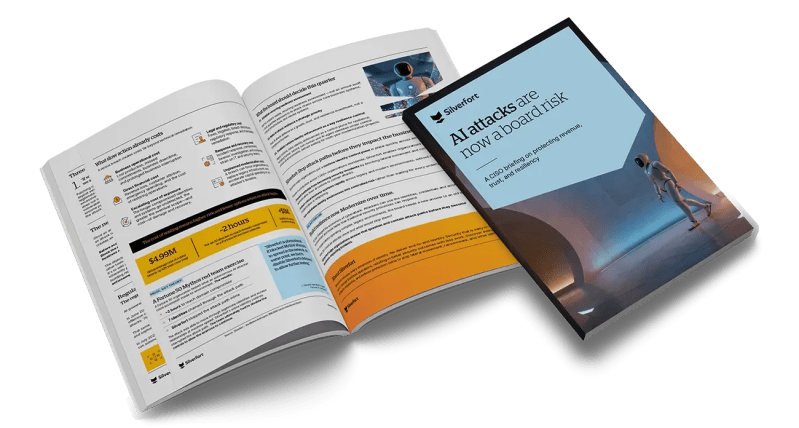
The economics of cyberattacks have changed
AI attacks compress the time between foothold and impact. Posture and risk management remain important, but they cannot be the end state. Stopping the attack becomes the resilience objective. Security leaders need identity controls that can block the next step inline, at runtime, before foothold becomes lateral movement, privilege escalation, or a business-impacting incident.
$4.99M
Global average cost of a data breach, up 12% year-over-year
~2 hours
For an AI attacker to reach domain compromise in a Fortune 50 red team exercise
+$1M
Additional cost forAI-driven attacks
Three assumptions security leaders should reconsider
01
"If we patch faster, we'll stay ahead"
Patching is essential, but AI attacks exploit existing identity weaknesses, legitimate credentials, and excessive privileges.
02
"We already have IGA and PAM"
IGA and PAM remain essential for governance, operational controls, and compliance, but they're too static and limited.
03
"Modernization will solve the problem"
Modernization is necessary, but it takes years—all while frontier AI capabilities are advancing rapidly and compressing attack timelines.
Identity: The new control point
Once an attacker has a foothold, nearly every next step requires authentication or authorization. That’s the moment Silverfort’s inline, runtime enforcement evaluates the request and can challenge, block, or contain it before the attacker reaches the next identity, privilege, or system.
Proof, not theory:
A Fortune 50 red team exercise
In a Fortune 50 red team exercise using Anthropic's Mythos, an autonomous AI attacker chained multiple identities to reach domain compromise in roughly two hours. Silverfort stopped the attack path inline, consistently, and where every other defense failed.

"Silverfort is phenomenal. It blocked Mythos' attempts to spread in the network. At some point, we had to disable Silverfort's defenses to allow further testing."
Security Operations Leader
Fortune 50 company
Regulatory pressure is moving in the same direction
In 2026, the Five Eyes cybersecurity agencies, the European Systemic Risk Board, and the European Commission each separately warned that frontier AI is compressing attack timelines and raising the bar on demonstrable resilience. The rulebook is still catching up. Supervisory expectations already have.
Read this brief to understand:
- Why identity, not the perimeter, is the critical control point for containing AI-powered attacks
- What slow action costs your organization and why you should act now
- What a Fortune 50 organization learned when it turned an autonomous AI attacker loose inside its own environment
- What the board should decide this quarter to build resilience without waiting on multi-year modernization
- How inline, runtime identity controls can stop attack paths before they impact the business

We push Identity Security further. Discover what's possible.
Set up a demo to see the Silverfort Identity Security Platform in action.