Looking for PAM alternatives? Secure privileged access at scale—without a vault.
Most PAM projects stall before they deliver, because vault-based approaches require enrolling every identity before protection begins. Silverfort protects privileged access at the moment of authentication, so you can reduce risk from day one—not at the end of a multi-year rollout.
- Automatically discover and protect every privileged identity at scale
- Enforce security at the moment of access
- Deploy fast with minimal operational overhead

Why you would use Silverfort alongside or instead of traditional PAM
If you're struggling with slow, complex deployments
With Silverfort, you can discover and protect privileged access across your environment within days, without internal resistance and friction. Protection isn't tied to vault enrollment.
If coverage gaps are undermining your risk posture
Immediately reduce risk by shifting enforcement to the authentication layer with Identity Security at runtime. Evaluate every request in real time and apply inline controls to reduce the blast radius of compromised credentials.
If you've only deployed a portion of your PAM licenses
Silverfort can extend protection to everything outside the vault while you right-size your existing investment, so unused licenses don't mean unprotected identities.
How Silverfort compares to vault-based PAM solutions
A side-by-side look at how Silverfort compares to vault-based PAM solutions such as CyberArk, Delinea, and BeyondTrust.
| Capability | Silverfort | Traditional PAM (CyberArk, Delinea, BeyondTrust) | Why It Matters |
|---|---|---|---|
| Comprehensive privileged access coverage | Yes | Vault enrollment required per account | Most environments have thousands of unvaulted identities, including NHIs. |
| Runtime authentication enforcement | Yes | Controls primarily applied through vault and session workflows | Enforcement at the authentication layer across protocols vaults can't see (Kerberos, NTLM, LDAP, legacy SSH). |
| Risk reduction | Yes | Partial | Privileged access is the most-targeted attack path — partial coverage leaves the highest-impact identities exposed. |
| Fast and automated onboarding | Yes | Often takes months to years, per environment | Every month spent onboarding is a month identities stay unprotected — fast time to protection collapses the window attackers can exploit. |
| NHI and service account protection | Yes | Requires manual discovery, onboarding and rotation | Service accounts are among the hardest and highest-risk identity types to secure at scale. |
| Seamless integration | Yes | Often complex, agent-based architectures | Infrastructure changes increase deployment friction and risk of breaking production systems. |
| Fast time to ROI | Yes | Typically multi-year rollouts; high professional services dependency | Traditional PAM rollouts can burn millions in licenses and professional services before any privileged identity is actually protected. |
| Legacy applications coverage | Yes | Partial | OT, legacy apps, and homegrown systems rarely make it into a traditional vault. |
| Built-in Zero Standing Privileges | Yes | JIT access available as add-on or limited scope | Standing privileges remain the primary attack path; JIT needs to be universal, not selective. |
| Capability | Silverfort | Traditional PAM (CyberArk, Delinea, BeyondTrust) |
|---|---|---|
| Comprehensive privileged access coverage | Vault enrollment required per account | |
| Runtime authentication enforcement | Controls primarily applied through vault and session workflows | |
| Risk reduction | Partial | |
| Fast and automated onboarding | Often takes months to years, per environment | |
| NHI and service account protection | Requires manual discovery, onboarding and rotation | |
| Seamless integration | Often complex, agent-based architectures | |
| Fast time to ROI | Typically multi-year rollouts; high professional services dependency | |
| Legacy applications coverage | Partial | |
| Built-in Zero Standing Privileges | JIT access available as add-on or limited scope |
Silverfort Vaultless Privileged Access Management (PAM)
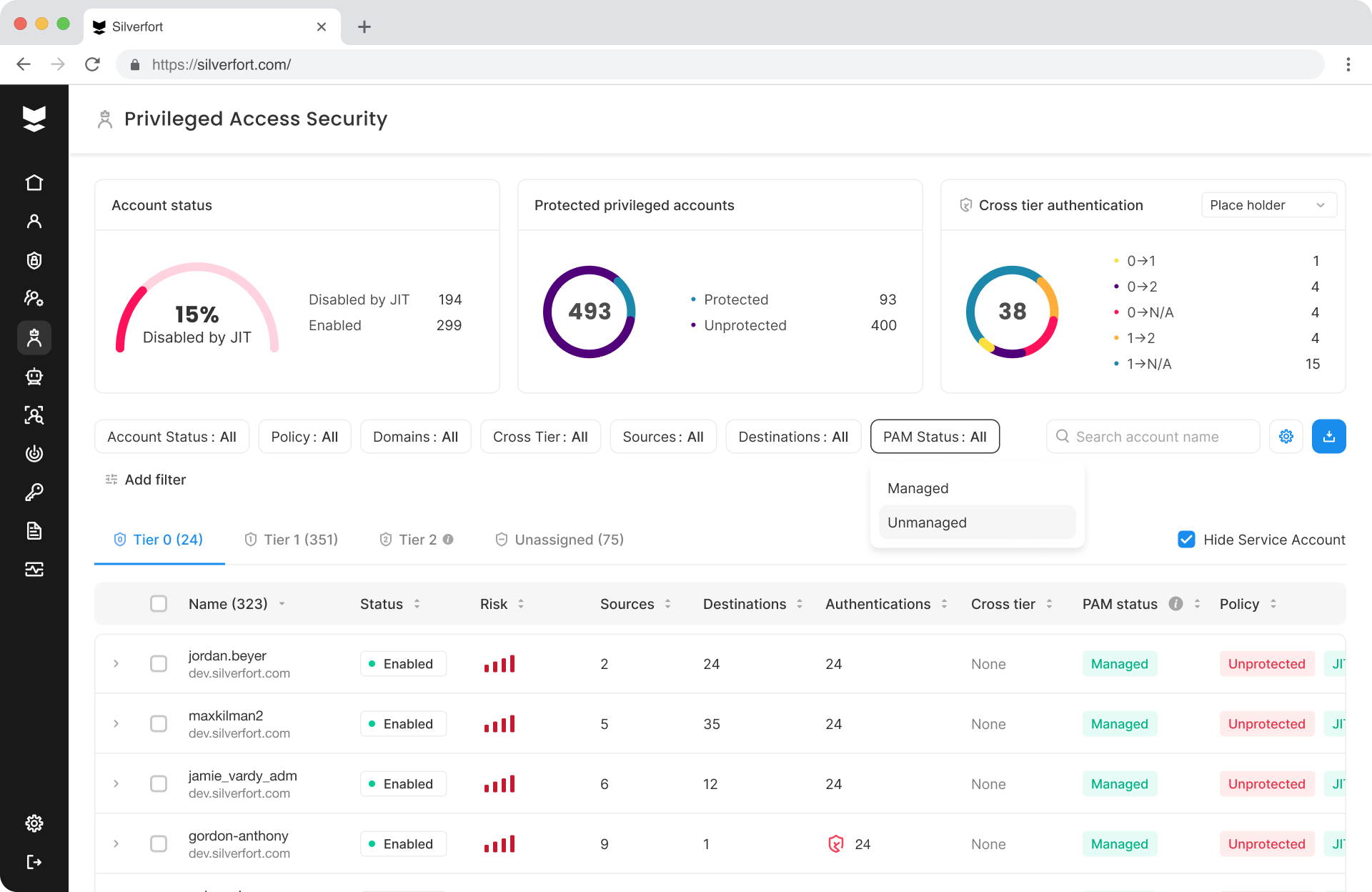
Traditional PAM primarily secures privileged credentials inside the vault. Silverfort extends protection to the authentication layer itself, so even if credentials are compromised, attackers can't move. With MFA, Just-in-Time access, tier segmentation, and access block, Silverfort delivers scalable protection and measurable risk reduction across all identity types.
MFA for every admin tool.
Stop credential misuse at the source. Silverfort enforces MFA across PowerShell, PsExec, WMI, RDP, SSH and homegrown applications that traditional PAM solutions can’t reach.
Service account protection without disruption.
Apply virtual fencing to restrict where and how service accounts authenticate — no password rotation, no application rewrites.For organizations where rotation isn't operationally viable, this extends meaningful protection to accounts that were previously uncontrolled.
Just-in-Time access, without the project.
Eliminate standing privileges across your environment in days, not quarters. Silverfort enforces JIT access at the authentication layer so access is granted only when needed and disabled at the moment it isn’t.

"Silverfort enabled us to reduce privileged risk within days — without deploying a complex PAM infrastructure."

See how Silverfort compares to traditional PAM solutions.
Book a demo with our team, or take a self-guided product tour to see Vaultless PAM in action.
FAQs
Is Silverfort a replacement for our existing PAM solution?
If there’s no vault, how does Silverfort control privileged access?
How is Silverfort’s Vaultless PAM different from password rotation?
Does Silverfort cover human admins, service accounts, and non-human identities (NHIs)?
Does Silverfort discover privileged identities based on actual usage?
Does Silverfort support Just-In-Time (JIT) access and Zero Standing Privileges (ZSP)?
Absolutely. Silverfort enables JIT access for privileged users, making Zero Standing Privilege (ZSP) practical and easily enforceable across your environment.