
While IAM is a foundational component, it is not synonymous with identity security.
Security teams often assume that because they’ve implemented an IAM solution, the identity layer is secure. But identity security requires far more: visibility into all identities (including non-human ones) – across their entire hybrid environment, enforcement of least privilege, continuous access verification, and threat detection for compromised credentials.
Meanwhile, attackers have adapted. They’re no longer “breaking in” — they’re logging in, using stolen or misused credentials, exploiting over-provisioned access, or abusing unmanaged service accounts.
To respond effectively, identity and security teams must rethink identity security as a unified, continuous layer of defense — one that spans human and non-human access, on-prem and cloud, real-time risk signals, and automation.
At Silverfort, we believe these 10 Commandments of Identity Security provide that strategic foundation. Whether you’re a CISO architecting a Zero Trust model or an identity engineer tackling daily risk, these commandments (aka principles) will help you mature your identity security program and build lasting trust across your enterprise.
The Identity Security Playbook
Your 5 step action plan to a sustainable Identity Security strategy

1. Know Thy Identities (Thou Shalt Know Thy Identities)
Understand and inventory every identity—human and non-human—across your environment.
The modern enterprise is a complex web of users, devices, applications, APIs, and automation scripts. Without full visibility into these identities and their entitlements, it’s impossible to protect them.
Example:
A company discovers it has over 4,000 service accounts—only 2,500 of which are actively in use. The rest, long forgotten, still hold privileged access.
Lesson:
Start with discovery. If you can’t see it, you can’t secure it.

2. Embrace Least Privilege (Thou Shalt Embrace Least Privilege Access)
Grant the minimum access necessary—nothing more.
Many breaches occur because users or systems retain access they no longer need. The principle of least privilege minimizes the risk of lateral movement by limiting access to what’s essential. This is foundational to your overall posture management strategy, so you can find and fix misconfigurations, use correlated intelligence to analyze privileges, and enhance your overall identity hygiene.
Example:
An intern inherits access to the organization’s source code due to role duplication. Even after leaving the company, that access remains active.
Lesson:
Design access to be role-specific, time-bound, and context-aware—not inherited or permanent.
3. Authenticate & Enforce with Strength (Thou Shalt Authenticate with Strength)
Move beyond passwords to secure, adaptive, and risk-based authentication.
Password-based security is no longer enough. Implement phishing-resistant multi-factor authentication (MFA) and enforce policies that adapt based on device type, location, and user behavior.
Example:
A finance user attempts login from an unfamiliar device abroad. The system prompts biometric MFA and triggers an approval workflow.
Lesson:
Effective authentication is seamless for legitimate users—and impenetrable for attackers.
4. Assume Compromise (Thou Shalt Assume Breach and Design for Compromise)
Design your identity systems with the expectation of compromise.
Zero Trust is built on the principle that no identity should be trusted by default. Systems must continuously verify identities and detect anomalous behaviors to reduce dwell time and mitigate damage.
Example:
An AWS key is accidentally published to GitHub. Automated behavior analytics detect abnormal activity and immediately revoke the key.
Lesson:
Treat detection and containment as equally important as prevention.
5. Govern the Identity Lifecycle (Thou Shalt Govern Identity Lifecycle Rigorously)
Automate and orchestrate identity management from onboarding to offboarding.
Manual identity processes are slow, error-prone, and risky. Implement automation to provision, adjust, and revoke access based on changes in role or employment status.
Example:
An employee’s departure triggers an automated deprovisioning process, revoking all access across systems within minutes.
Lesson:
Security depends on precision—and precision depends on automation.
6. Secure Non-Human Identities (Thou Shalt Secure Non-Human Identities Equally)
Treat service accounts, APIs, and bots with the same rigor as human users.
Non-human identities now outnumber humans in many enterprises. These entities often have elevated privileges but receive far less oversight.
Example:
A legacy script uses hardcoded credentials that haven’t been rotated in over two years. Those credentials have access to sensitive databases.
Lesson:
Machine identities are targets too. They need governance, rotation, and visibility.
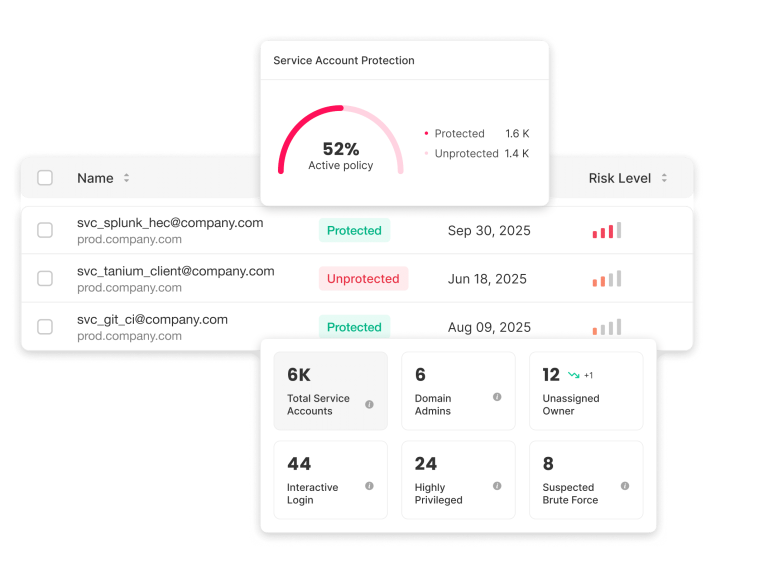
Non-human identity security
Every NHI—in sight and under control
- Automatically discover every NHI in your environments.
- Map their activities and establish baselines.
- Enforce control and fence their activity.
7. Continuously Verify Access (Thou Shalt Verify Access Continuously)
Access should be temporary by default and regularly re-evaluated.
What was appropriate yesterday may be excessive today. Implement access reviews, dynamic revocation, and re-authentication triggers to ensure only the right users have the right access at the right time.
Example:
A developer receives temporary access to production logs for a one-week project. The system automatically revokes access after 7 days unless renewed.
Lesson:
Trust must be earned—and re-earned—continuously.
8. Enforce Policy with Automation (Thou Shalt Enforce Policy with Automation)
Use real-time context and automation to drive access decisions.
Manual access approvals don’t scale. Dynamic, risk-based policies must guide enforcement based on user behavior, time of day, location, and device risk posture.
Example:
A contractor, who typically logs in from a corporate-issued laptop and signs off by 4:00 PM AEST attempts to access a sensitive source code repository from a personal device at 11:30 PM. A policy engine detects the unusual activity based on the user’s historical behavior, flags the anomaly, and triggers step-up authentication. When MFA fails, the system blocks access and notifies the security team in real time.
Lesson:
Real-time policy enforcement enables organizations to catch anomalies before they become incidents — with the speed and precision manual reviews can’t offer.
9. Protect Identity Infrastructure (Thou Shalt Protect the Identity Infrastructure)
Secure and monitor the platforms that manage identity with a single platform that can integrate into every type of identity infrastructure. It should be vendor-agnostic, lightweight and give you a single control plane to discover, manage and protect your entire identity fabric and the identities within.
Identity providers (IdPs), federation services, domain controllers, and privileged access tools are Tier 0 assets. If they’re compromised, everything downstream is at risk. At the same time, any identity can be an entry point for attackers. Use solutions that are lightweight and easy to deploy so you can see and investigate all identities across all systems.
Example:
Admin access to the identity provider is restricted with FIDO2-based MFA. All changes are logged and monitored in real time.
Lesson:
Your identity infrastructure is the crown jewel—treat it as such by bringing all identity data into a single view that’s easy to correlate and analyze.
10. Align with Standards and Frameworks (Thou Shalt Align with Security Frameworks and Standards)
Use established frameworks to benchmark, guide, and mature your identity strategy.
Standards such as NIST 800-63, NIST 800-207 (Zero Trust), ISO/IEC 27001, and CIS Controls provide structure for improving identity maturity and demonstrating compliance.
Example:
A multinational enterprise maps its access control policies to NIST 800-207 and uses CIS Controls v8 for auditing and reporting.
Lesson:
Frameworks are your compass—not a compliance checklist.
A call to live by the new rules of identity
Identity is no longer just a component of cybersecurity—it is cybersecurity.
To succeed in a Zero Trust world, organizations must secure both human and non-human access with equal diligence.
These 10 commandments serve as a practical blueprint for evolving your identity security posture—from visibility and governance to enforcement and automation.
At Silverfort, we empower organizations to implement these principles at scale. Our platform extends identity security to assets and environments where traditional IAM tools fall short—including legacy systems, command-line interfaces, and non-federated applications.
Because if you can’t secure identity, you can’t secure the enterprise. Learn more about the Silverfort way by visiting here.