Non-human identities have quietly become the most prevalent identity type in enterprise environments. Yet the security infrastructure built to manage identity was designed for people, not machines.
The result is an attack surface that grows with every new integration, AI workflow, and automated pipeline—one that existing identity programs were never designed to govern. Secrets management, including token rotation, addresses pieces of the problem. What’s missing is a coherent model for discovering, governing, and enforcing policy across the full NHI landscape.
The scale and governance gap
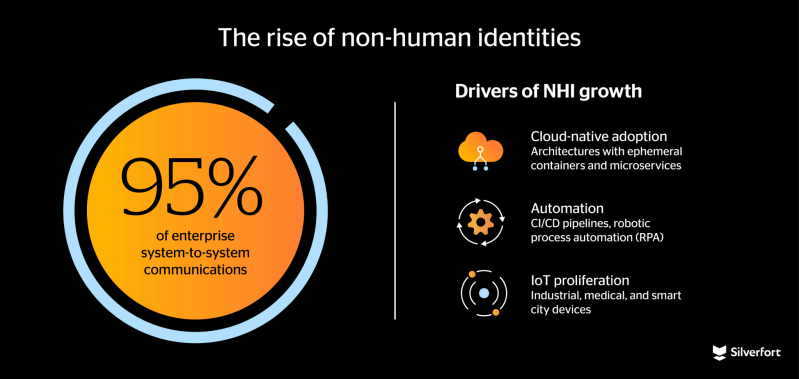
Non-human identities, including service accounts, API keys, and OAuth tokens, have grown exponentially as organizations embrace cloud infrastructure and DevOps pipelines. In most enterprise environments, NHIs now outnumber human identities by ratios of 50:1 or more.
The rise of AI agents adds another accelerant. Every agentic workflow and model-to-service connection introduces new identities and credentials. Organizations that were already struggling to track their NHI inventory are now seeing that inventory expand at an unprecedented rate.
Scale is only the first problem. Unlike human users, NHIs exist outside the standard identity lifecycle. There is no joiner-mover-leaver process, no periodic access review, and no meaningful equivalent of controls like MFA or SSO. The governance frameworks organizations spent years building for human identity simply don’t extend to machine identities.
The fragmentation underneath
The challenge intensifies in hybrid and multi-cloud environments. On-prem Active Directory at least offered a single plane of control: one system, one team, one request flow. Cloud environments shattered that model. Today, identity exists across cloud identity providers, SaaS applications, cloud infrastructure, DevOps tooling, AI platforms, and an increasingly dense web of integrations.
Historically, service accounts were managed centrally for backend automations. Today, AI agents and low-code integrations have distributed identity creation across the organization, while responsibility still falls on IAM and security teams that often lack visibility into what’s being created and where.
NHIs are inherently decentralized because they exist to support point-to-point integrations: Salesforce to Snowflake, Jira to Slack, CI/CD pipelines to cloud providers. Every integration creates identities and credentials across multiple systems. The fragmentation problem for NHIs is structurally worse than it ever was for human identities.
The core challenge of static credentials
Their credentials are often static and long-lived, because rotating them risks breaking critical processes—and those credentials have a habit of appearing in places they should not: code repositories, configuration files, logs, CI/CD artifacts. For an attacker, a compromised NHI credential is a skeleton key: high privilege, no MFA, no session monitoring, and no human owner watching. Research across hundreds of enterprise environments shows that 80% of NHIs have high or critical posture issues that expose them to common attack techniques.
This makes NHIs attractive targets: they combine broad privileges with low operational friction, and because they automate business-critical processes, they often hold standing access far beyond what they use. Attackers scan repositories, logs, and public sources for these credentials, and once compromised, they provide a fast path to lateral movement, persistence, and data access.
The more systemic risk is supply-chain compromise. Organizations routinely grant vendors and external services broad integration access with little visibility into the posture on the other side.
Third-party risk and supply chain security are therefore core parts of any serious NHI security strategy. A recent example illustrates the risk: attackers compromised a widely-used open-source CI/CD scanning tool, injecting a payload that harvested secrets from every pipeline that ran it.
How do organizations secure their NHI estate at scale? Here are the six critical steps:
1. Start with visibility—but don’t stop there
Any credible NHI security program starts with a comprehensive inventory. Most organizations still cannot answer a basic question: How many non-human identities do we have, and where do they live?
Only 5.7% of organizations report being able to accurately inventory all NHIs in their environment (Silverfort, Insecurity in the Shadows, 2025). The answer is typically scattered across Active Directory, cloud identity providers, SaaS platforms, and cloud infrastructure, each managed by different teams with different tooling and ownership models.
Effective NHI security requires aggregating this view into a unified inventory across every environment. This is not a differentiator, it is a prerequisite. Without it, everything downstream—posture management, threat detection, and enforcement—operates on incomplete data.
2. Measure posture by behavior, not just configuration
Inventory tells you what exists. Posture intelligence tells you what’s wrong. That requires behavioral context, not just configuration scanning. The most impactful posture findings come from analyzing what NHIs actually do versus what they are permitted to do.
A service account with access to 200 servers that only ever touches one has 199 unnecessary attack paths. Identifying over-privilege at the individual permission level, based on observed behavior, turns posture management from a checklist exercise into a meaningful risk reduction program.
The same applies to dormant identities. Without a formal lifecycle, NHIs accumulate indefinitely—and the highest-value findings come from identifying not just these inactive accounts, but unused individual permissions on active ones.
Exposure is a posture signal too. For organizations still reliant on static credentials—which is nearly all of them—secret scanning can identify credentials exposed in repositories, configuration files, logs, or public sources. That exposure data should directly inform posture prioritization and enforcement decisions.
3. Close the loop: from find to fix
Identifying risk is necessary but insufficient. What matters is whether organizations can act on findings efficiently.
Effective remediation starts with owner mapping: understanding who created an NHI, who is responsible for it, and who should remediate when something goes wrong. This is both a security requirement and a compliance necessity. An over-privileged NHI with no identifiable owner is effectively impossible to remediate safely—no security team wants to disable a credential tied to an unknown business process.
Automated owner detection through metadata, tagging conventions, and behavioral signals helps resolve much of this ambiguity. Combined with assignment workflows and event-driven ticketing, it turns posture findings from informational alerts into actionable remediation tasks routed to the right owner.
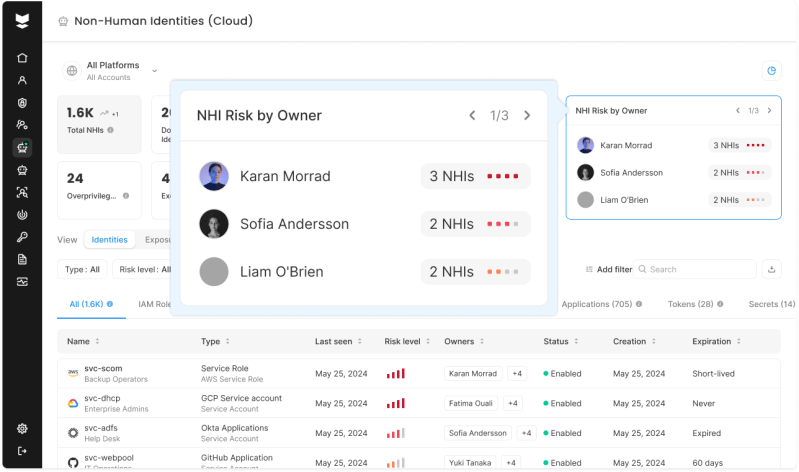
With ownership established, organizations can act on findings directly: contextual guidance tied to each finding—which role to scope down, which policy to tighten—alongside the ability to take direct action such as rotating passwords, restricting access, or applying enforcement policies without waiting for a manual remediation cycle.
4. Automate the lifecycle
Manual remediation does not scale when organizations manage tens of thousands of NHIs. But automation is a means, not an end. Used only to react faster to the symptoms of missing governance, it leaves organizations chasing their own tail. Used to operationalize governance, it becomes the mechanism that holds the model in place at machine scale.
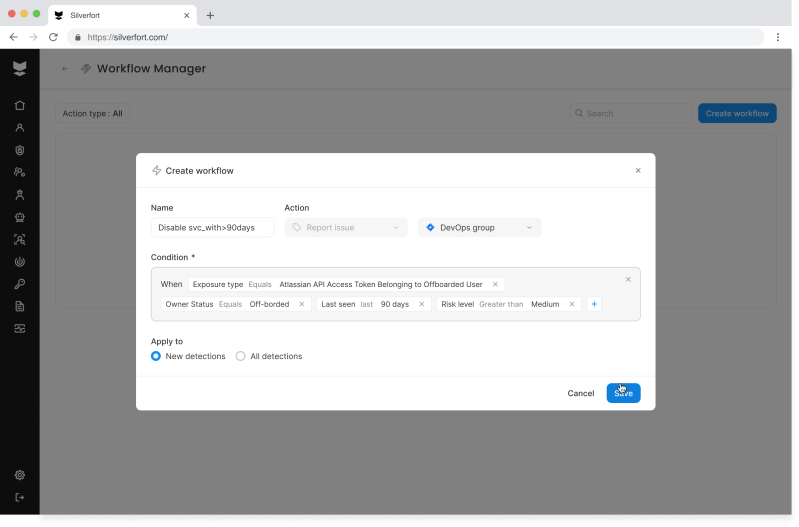
The strongest NHI security programs increasingly rely on policy-driven automation to enforce lifecycle governance—establishing it where none existed, and maintaining it as the estate grows. This includes:
- Automatic deprovisioning: dormant NHIs are disabled after defined inactivity thresholds, with safeguards to avoid disrupting production systems.
- Automated owner assignment: identities created within specific environments are automatically mapped to the teams responsible for them.
- Event-driven ticketing: findings are routed directly to the appropriate owners with full context and remediation guidance.
5. Detect threats across the full identity graph
NHI detection in isolation misses the bigger picture. Modern attacks rarely stay confined to a single identity type or platform. A compromised human account moves laterally using federation, creating service accounts or tokens along the way to access sensitive data or establish persistence. Viewed independently, each step can appear routine.
The value of Identity Threat Detection lies in two things: correlating activity across both human and non-human identities to reconstruct the full attack chain, and baselining each identity’s normal behavior so deviations stand out.
This cross-identity correlation is one of the most important capabilities in modern NHI security. Behavioral baselines make subtle deviations visible—actions that appear normal in isolation become suspicious when correlated against the identity’s typical behavior and the activity that triggered them.
Effective response also depends on giving practitioners the context and tools to act quickly: clear remediation guidance alongside workflows that streamline actions like restricting access, revoking sessions, or disabling accounts.
Due to the speed attackers move in from the moment of breach, it is essential to significantly reduce the time from detection to containment, especially when the response path is pre-built rather than improvised.
6. Enforce access at runtime
Most organizations already have visibility tooling. Far fewer can enforce policy at runtime. Organizations with strong NHI security posture are the ones that can actually constrain what NHIs are allowed to do at authentication time.
Geo-fencing is one example. NHIs tend to operate from predictable infrastructure: fixed IP ranges, specific cloud regions, or known network segments. Their predictable nature makes them well suited to controls such as virtual fencing or cloud-native conditional access policies. Behavioral analysis can identify these patterns automatically and generate enforcement policies directly in the identity provider. No human operator could manually create per-identity access policies at this scale. Behavioral analysis combined with programmatic policy creation makes it tractable.
The practical value of enforcement is blast radius reduction.
Perfect credential hygiene is unrealistic for most organizations. But even when credentials are compromised, restricting where and how they can be used dramatically limits what attackers can do with them. Enforcement is what turns credential risk from an open vulnerability into a controlled, manageable one.
Take action on securing the full scope of NHIs
Most organizations still lack even basic visibility into their NHI estate, and the approaches that do exist tend to solve only part of the problem—visibility without enforcement, or posture management without remediation depth.
The harder challenge is achieving consistent visibility and enforcement across hybrid environments, especially extending into on-premises Active Directory where many legacy service accounts still reside, while correlating that activity with cloud and SaaS identities in a unified identity graph.
Taken together, these principles point to a single destination: governance for non-human identities that never had it. Visibility, posture, ownership, automation, detection, and enforcement are not ends in themselves—they are how an organization finally sees its NHI estate, builds a model to govern it, and keeps that model intact as the estate grows.
The organizations that treat NHI security as a first-class discipline, rather than an extension of human IAM, will be the ones that close the gap before attackers exploit it.
Learn more about Silverfort NHI security or take a product tour.