
Traditional PAM solutions leave critical blind spots—making it difficult for organizations to effectively secure privileged accounts.
These include lengthy deployment cycles and manual account discovery that result in delayed identification of privileged accounts. At the same time, gaps in enforcing least privilege, combined with admins’ ability to bypass security controls, leave organizations vulnerable to compromise.
Simply managing privileged accounts is not enough. Without implementing concrete security controls, the volume of access pathways, privileged identities, and entitlements can quickly spiral out of control. In order to truly protect access to the organization’s crown jewels, we must rethink how privileged access is secured, ensuring it does not become a gateway to attackers.
In this post, we will explore the different capabilities of Silverfort’s newly launched Privileged Access Security (PAS) module. We will explain how PAS enables you to secure privileged accounts easily through automated discovery and classification, fencing, and enforcement of least privilege and Just-in-Time (JIT) access policies for all your privileged users.
Silverfort’s PAS module is a core element of our Vaultless PAM approach – a modern way to secure privileged access beyond the scope of traditional vaults. By enforcing security controls inline with authentication flows, Silverfort eliminates the need for complex infrastructure while ensuring that every access request is continuously verified and protected.
The privileged access blind spots 101
The traditional approach to managing privileged accounts with PAM solutions focuses on controlling and protecting credentials. However, it fails to address access controls—making it easier for attackers to move across environments undetected.
4 key limitations of traditional PAM solutions include:
- Slow and complex onboarding: According to Osterman Research, only 10% of organizations successfully complete their PAM projects, often due to the time and resources required to onboard all systems and accounts. This incomplete coverage leaves many privileged accounts unmanaged and vulnerable to compromise, creating gaps attackers can easily target.
- Discovery gaps: Traditional PAM tools struggle to identify all privileged accounts, users, and the systems they access. This is especially true for service accounts and other NHIs. These unknown or unmonitored accounts become hidden entry points for attackers, who exploit them to escalate privileges and move laterally across environments.
- Bypassing PAM: Administrators often bypass PAM by directly checking out credentials or accessing servers outside of approved workflows. This creates unmonitored activity that attackers can replicate or exploit.
- Privileged Access Abuse: Misuse of privileged accounts, such as using elevated access for non-critical tasks, expands the attack surface. When these accounts are used improperly, the risk of compromise increases, making it harder to detect malicious activity amid legitimate actions.
In today’s complex hybrid environments, organizations need to deploy a proactive approach that goes beyond managing their privileged accounts and prioritizes security for any privileged identity, at runtime.
Silverfort’s Privileged Access Security (PAS)
Silverfort offers a new approach to overcoming the limitations of traditional PAM solutions through its unique architecture, which integrates seamlessly across on-prem and cloud environments.
With Silverfort PAS, organizations can automatically discover and classify all privileged accounts based on user activity, and gain comprehensive visibility into all privileged identities, cross-tier authentications, and access requests. This allows them to identify whether regular accounts are being used with privileged intent, and which identities have excessive privileges.
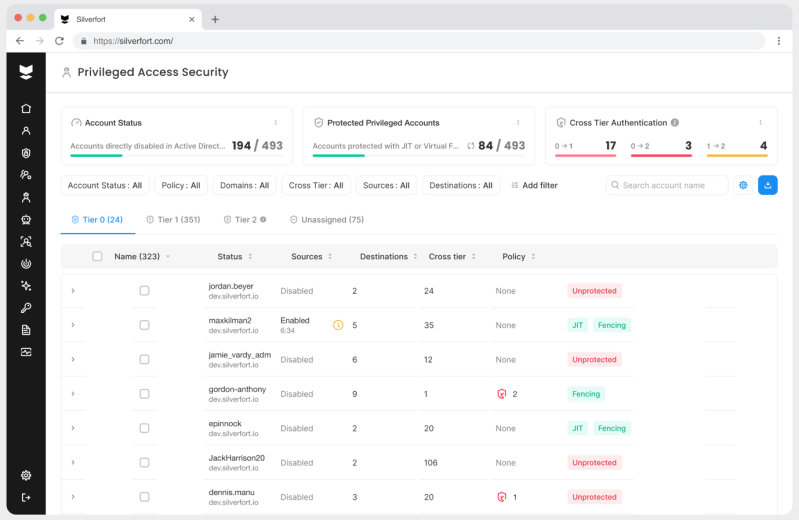
Another main capability of PAS is Just-in-Time (JIT) access—eliminating standing privileges and ensuring that privileged accounts receive the necessary permissions—only when needed and for a limited duration.
Silverfort PAS secures privileged accounts in three main steps:
- Discovery and classification of all privileged accounts.
- Fencing privileged identities to their intended purpose.
- Enforcing frictionless Just-in-Time (JIT) access policies at scale.
Automated discovery and classification
The first step to properly securing all privileged accounts is understanding exactly who your privileged identities are and what they access. Key questions include:
- What privileged accounts do you have?
- How many privileged identities are there in your environment?
- Which assets or systems do they access?
Upon deploying Silverfort’s PAS, the platform automatically discovers, identifies, and classifies all privileged accounts based on actual user activity and authentications.
Silverfort can also classify different privileged user tiers, helping organizations prioritize and implement tailored security controls for each tier. By monitoring behavior, Silverfort detects and alerts on risky cross-tier access attempts, enabling organizations to proactively address privilege escalation threats.
Fence privileged accounts to their intended purpose
Once full visibility is achieved, the next step is to configure a virtual fence around privileged accounts, to ensure they are used for their intended purposes.
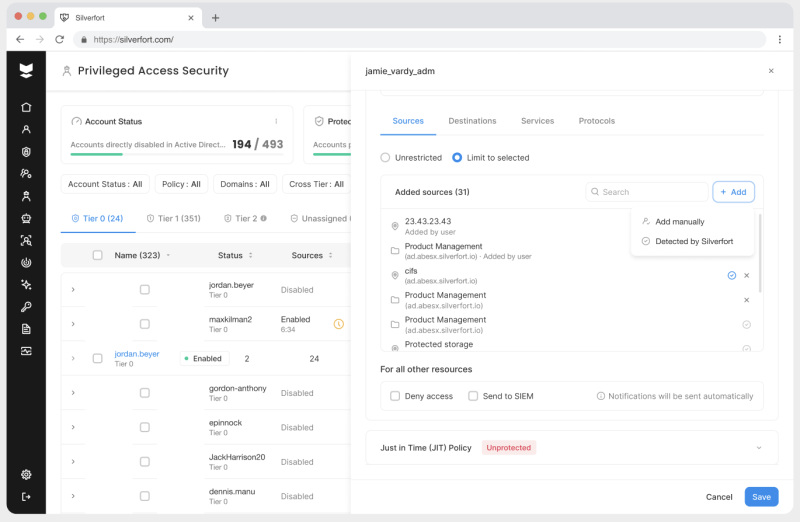
Silverfort’s fencing capabilities restrict privileged accounts to only the resources they are intended to access, blocking any unnecessary or unauthorized activity. This is enforced through granular controls over source, destination, and protocol, while preventing cross-tier access and enforcing strict segmentation—reducing opportunities for misuse and lateral movement.
Silverfort can automatically recommend least privilege policies based on real usage patterns. These policies define exactly where and how privileged accounts should be used, ensuring they are only used within their intended parameters.
Seamless Just-In-Time access
Applying time-sensitive Just-In-Time access policies is the next step in securing privileged users with PAS. Using Silverfort’s JIT capabilities, organizations can render accounts completely unusable until access is explicitly required. This approach eliminates unnecessary standing privileges and enforces strict access controls.
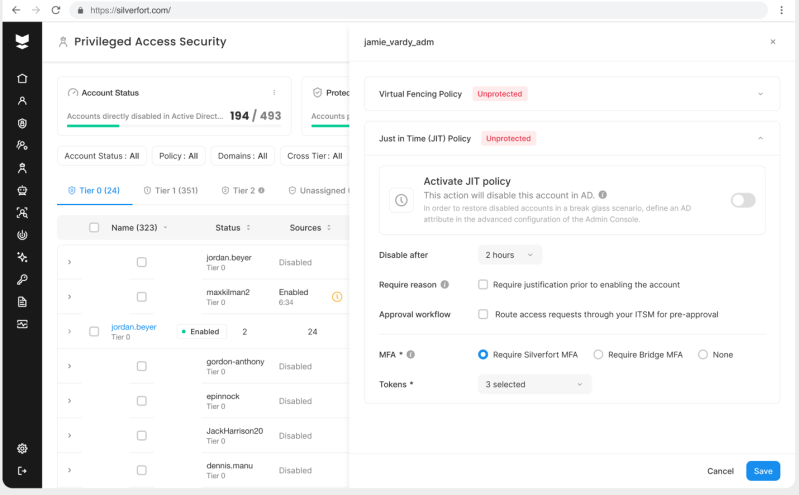
JIT policies are easy to configure in the Silverfort console, where admins can design frictionless access policies for each user and assign the duration of their access. Admins can select the type of authentication and, if MFA is selected, which token needs to be activated.
By eliminating standing privileges, Silverfort reduces reliance on controls such as password rotation and vaulting—streamlining operations while improving security and efficiency.
Learn more about Silverfort’s Privileged Access Security
With Silverfort’s Privileged Access Security (PAS) module, privileged users are secured with runtime enforcement controls. By automating the discovery and classification of privileged accounts, enforcing least privilege principles and enabling JIT access policies, Silverfort makes it easy to secure privileged access quickly, seamlessly, and at scale.
Want to learn how to secure privileged access at scale? Read more about our Vaultless PAM approach in our latest guide, “Securing Privileged Access at scale: From blind spots to resilience.”